
In the last installment of ARTDEX’s Art and Money series, Why Art Valuation Is Never Just About Money – Art and Money Series Part 3, we challenge the idea that art valuation is simply about price. Moving beyond sticker shock and surface-level complexity, we reveal how art prices function as signals of confidence, trust, and long-term positioning rather than straightforward market metrics. It explores why art resists standardization, how differing incentives across artists, galleries, collectors, and institutions shape value, and why consistency matters more than short-term sales tactics.
Now, we examine how access quietly shapes valuation long before prices are set.
When Valuation Depends on Access
Across the first three parts of the Art and Money series, we explored why art appears expensive, why pricing is structurally complex, and why valuation is never just about money. This fourth installment turns toward a more uncomfortable but unavoidable question: who is actually able to participate in the art market long enough to build value?
For artists, collectors, and art professionals alike, access is often treated as secondary to talent, taste, or market forces. In practice, access functions as a gatekeeping mechanism — shaping who is visible, who is sustainable, and whose work ever reaches a point of valuation.
Access Is Not Neutral
The professional art world requires significant upfront investment long before consistent income appears. Artists routinely fund production, documentation, framing, shipping, storage, and promotion without guaranteed returns. These costs are rarely acknowledged in conversations about pricing.
Unpaid or underpaid labor remains normalized through internships, assistant roles, open calls, and exhibitions framed as “opportunities.” While these pathways are often presented as merit-based, they disproportionately favor those with external financial support.
Access, therefore, is not evenly distributed. It is conditioned by who can afford risk, and for how long.
The Economics of Staying Visible
Visibility is currency in the art market. Maintaining it requires resources: time, money, and geographic mobility. Artists who disappear from exhibitions, fairs, or online platforms are often interpreted as losing momentum, regardless of the quality of their work.
This creates a quiet but powerful filter. Persistence becomes a prerequisite for success, yet persistence itself carries financial cost. Those unable to sustain visibility are often excluded before their work can be meaningfully evaluated.
Geography as a Structural Barrier
Despite global digital reach, the art market remains geographically concentrated. Major cities continue to house the majority of galleries, collectors, institutions, and fairs. Physical proximity still shapes access to networks, representation, and opportunity.
Artists working outside these hubs face higher barriers: travel costs, shipping expenses, and limited exposure to decision-makers. Online platforms expand reach, but they rarely replace the advantages conferred by proximity to power.
The Cost of Being “Emerging”
The term “emerging artist” is often used optimistically, but it frequently masks prolonged financial precarity. Low prices, speculative exposure, and deferred compensation are justified as necessary steps toward future success.
This model assumes that artists can absorb years of instability. Those who cannot are filtered out — not because of lack of quality, but because of economic constraint.
For collectors and professionals, recognizing this dynamic is essential. The pool of visible artists is already shaped by who could afford to remain visible.
Platforms as Market Expanders: Transparency, Access, and Responsible Inclusion
Digital art platforms have expanded access to the art market by increasing price visibility, reducing geographic barriers, and creating entry points for artists historically excluded from local gallery systems. For many emerging artists, platforms offer a first sustained opportunity to reach collectors beyond established art capitals and narrow curatorial circles.
Transparency, when designed responsibly, can correct long-standing imbalances. Visible pricing and standardized processes reduce insider advantage, but equity requires more than openness alone. Algorithmic visibility and scale-driven incentives must be carefully managed to avoid rewarding volume and self-promotion over sustainable artistic practice.
At their best, platforms balance access with long-term value — supporting emerging talent, contextualizing prices, and resisting downward pressure that erodes artists’ markets. Rather than replacing traditional gatekeepers, platforms have the opportunity to redefine them: enabling broader participation across geographies, aesthetics, and career stages while strengthening, not diluting, market credibility.
Who the Current Pricing System Protects
High prices and controlled valuation protect artists who have already achieved representation and institutional recognition. These mechanisms stabilize markets and reduce volatility for collectors.
However, they also reinforce exclusion. Artists outside the system absorb risk without access to the protections that stable pricing provides. This selectivity is structural, not accidental.
Understanding this does not invalidate the system, but it does demand honesty about who it serves.
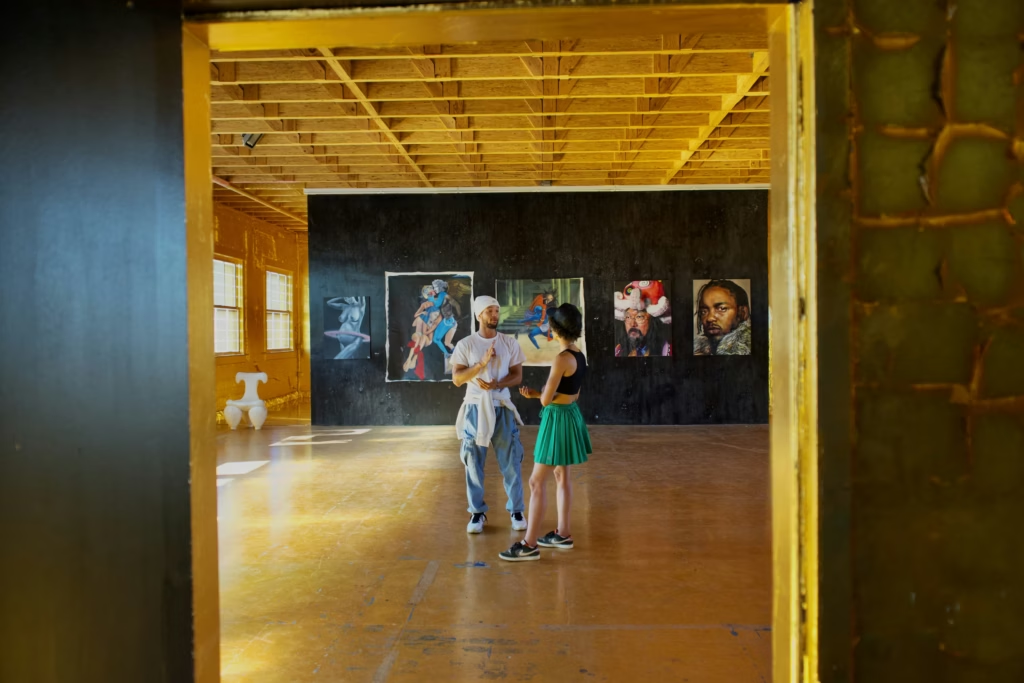
Toward a More Sustainable Art Economy
A more sustainable art economy does not require flattening prices or eliminating professional standards. It requires acknowledging uneven risk and compensating labor fairly.
Practical steps include:
- Clear production budgets and expectations
- Tiered pricing and access models that preserve value
- Greater accountability for unpaid labor
Sustainability emerges when participation is not dependent on personal wealth.
Closing Reflection: Participation Shapes Value
The question is not whether art should be expensive or affordable. The more pressing question is who is able to remain long enough to be valued at all.
Art valuation cannot be separated from access. For artists, collectors, and professionals, recognizing this connection is essential to building a market that values not only objects, but the people who make and sustain them.