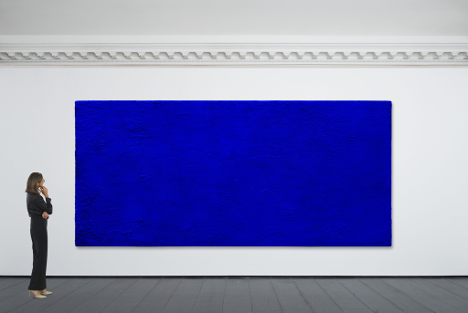
In a dazzling Paris evening sale in October 2025, Yves Klein’s monumental California (IKB 71) (1961), a fourteen-foot expanse of pure ultramarine, sold for €18.4 million (about $21.4 million), the highest price ever paid for the artist in France. The work, created just a year before Klein’s untimely death, stands as both an apex of his painterly ambition and a revelation of how color itself could transcend the limits of matter.
For those who have long followed Klein’s radical pursuit of the immaterial, the sale was not merely a market victory. It was an affirmation that his singular vision, distilled into his signature hue, International Klein Blue (IKB), continues to challenge, seduce, and inspire both artists and collectors six decades later.
The Blue That Became the Infinite
In the mid-twentieth century, when most of Europe’s avant-garde artists sought liberation through gesture and abstraction, Yves Klein turned instead to the infinite stillness of a single color. For him, blue was not descriptive but metaphysical, a passageway to boundlessness.
“Blue,” he wrote, “has no dimensions; it is beyond dimensions, while the other colors are not.”
The monochrome, in Klein’s hands, became a portal. In works such as California (IKB 71), the artist covered vast surfaces with a deep, matte ultramarine that resists the eye’s attempts to fix focus. The pigment seems to hover, radiate, even breathe, creating an experience that is less about looking at a painting and more about entering an atmosphere.
Painted during his travels in the United States, ‘open window to freedom’: California (IKB 71) belongs to Klein’s most ambitious late series. It is the largest blue monochrome from his hand still in private ownership, a painting that overwhelms through its sheer scale and density, where the viewer feels suspended in an endless field of color. The title, California, suggests not geography but a state of illumination, a place where sea, sky, and light converge in a single, pure sensation.
The Alchemy of Pigment: IKB as Material and Metaphor
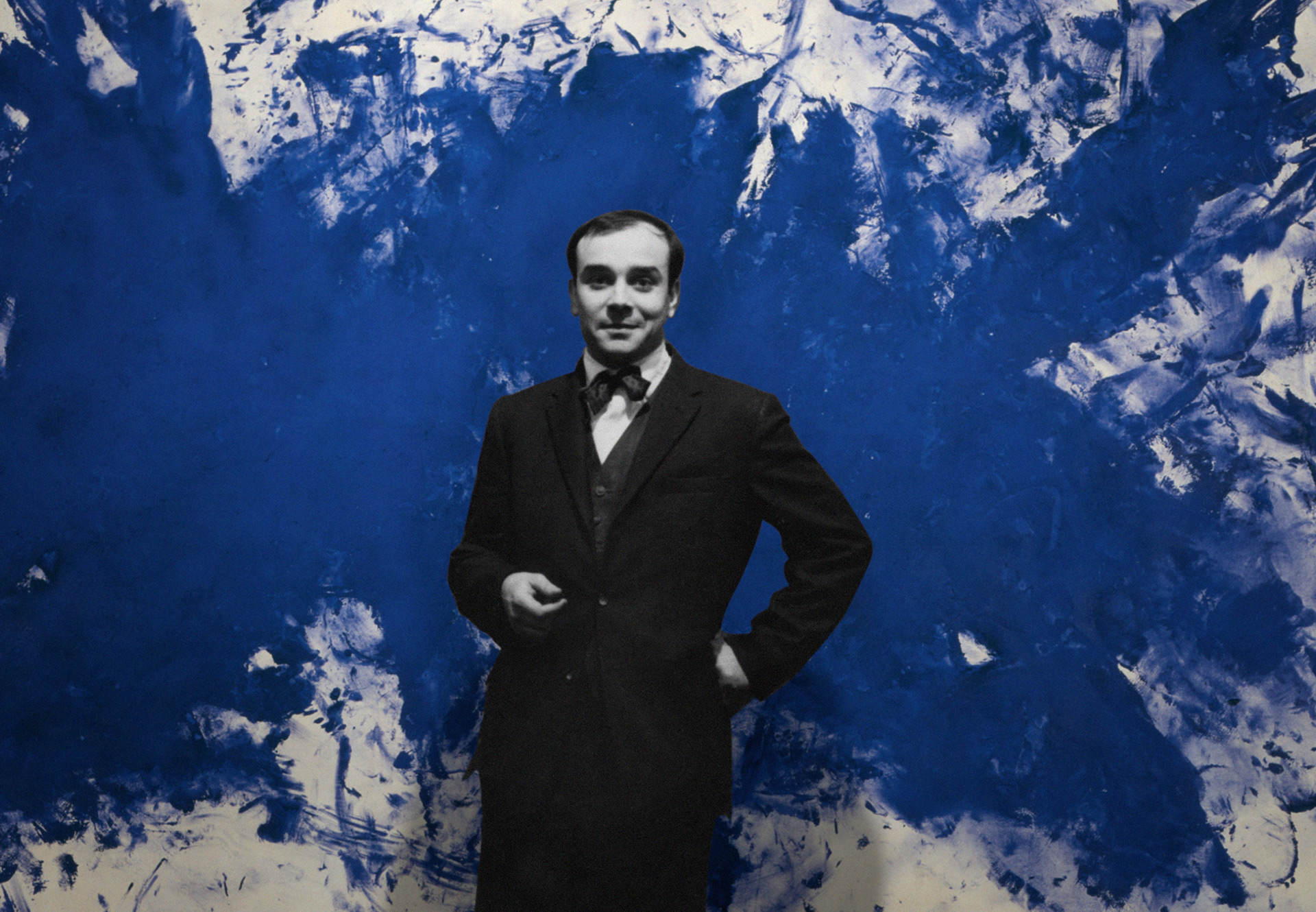
Klein’s genius lay not only in his vision but in his insistence that the material of color could embody the immaterial. His celebrated International Klein Blue was no ordinary pigment. Working with chemist Édouard Adam, Klein devised a method of binding ultramarine with a synthetic resin that preserved the pigment’s raw, dry brilliance rather than dulling it in oil or glue.
The result was a surface unlike any other, velvety, absorbent, at once physical and dematerialized. The matte intensity of IKB denied reflection and instead absorbed light, dissolving the boundary between pigment and space. Each particle of blue became, in Klein’s poetic conception, “a living atom of sensibility.”
Technically meticulous and conceptually radical, this fusion of chemistry and spirituality made Klein one of the rare artists whose material innovations altered the very language of modern painting. The surface of California (IKB 71) is not smooth but textured, embedded with small stones and grains of sand that catch light unpredictably, evoking seabed or celestial terrain. Here, the earth itself is transfigured through color into spirit.
Immaterial Sensibility: The Void as Artwork
Klein’s monochromes were never meant to be decorative; they were meditations on the void. His lifelong project, what he called “the immaterialization of painting,” sought to liberate art from the tyranny of representation.
He dreamed of a “pure sensibility” that could exist without object or image. This ambition reached its most provocative expression in The Void (Le Vide) (1958), when he presented an empty white gallery as an artwork, and in his famous “Zones of Immaterial Pictorial Sensibility,” which he sold as receipts for invisible art.
Within this conceptual cosmos, California (IKB 71) serves as a threshold, not a depiction but an embodiment of the immaterial. Standing before its vast blue field, one senses both presence and absence, fullness and emptiness. The blue becomes a paradox: a visible manifestation of the invisible, an invitation to dissolve the self into pure perception.
When Blue Turns to Gold: The Market and Its Meanings
That such an artwork, devoted to the immaterial, now commands over €18 million in a Paris sale is a poetic irony that Klein himself might have relished. During his lifetime, he sought to fuse art, economy, and spirituality, famously exchanging his invisible zones for gold leaf, half of which he ceremoniously cast into the Seine.
Today’s collectors continue that dialogue between material value and immaterial meaning. The record sale of California (IKB 71) underscores how Klein’s art has transcended the historical avant-garde to become a cornerstone of postwar modernism, rivaling the market presence of Rothko or Newman. But more profoundly, it signals a collective hunger, in both artists and audiences, for works that speak to transcendence amid material excess.
The blue, in other words, still buys belief.
The Artist’s Legacy in the Contemporary Imagination
Klein’s influence radiates far beyond his lifetime. His chromatic radicalism paved the way for Minimalism, Conceptual Art, and performance-based practices. His Anthropometries, in which naked models coated in IKB imprinted their bodies onto canvas, redefined authorship and gesture. His Fire Paintings turned combustion into a creative force.
Yet it is the blue that endures, the monochrome as a site of surrender and revelation. Artists today, navigating a hyper-visual, digitized world, continue to draw from Klein’s belief that simplicity can be the ultimate intensity, that one color, one act, can encompass the infinite.

Entering the Blue, the Provocation Lives On
In the end, ‘open window to freedom’: California (IKB 71) is not a painting to be owned but an experience to be entered. Its luminous field suspends the viewer between sky and depth, body and void. The pigment becomes air; the surface becomes silent.
As the gavel fell in Paris, the art world witnessed not only a market triumph but a metaphysical one, proof that Yves Klein’s “eternal blue” continues to expand, unconfined by walls, centuries, or price tags.
For every artist who dreams of distilling the infinite into form, Klein’s blue remains both a challenge and a promise: that the immaterial is never beyond reach, it only requires us to see beyond the visible.