A Gesture That Altered the Course of Sculpture
When Alexander Calder casually remarked that it “would be fun” to set abstract art in motion, he articulated an intuition that would reverberate across the history of modern art. What reads as lightness of intent belies the magnitude of its consequence. In the charged atmosphere of early 20th-century abstraction — where artists sought to liberate form from representation — Calder introduced not merely a new technique, but a new condition of being for sculpture. His work dissolved the long-standing expectation that sculpture must be fixed, grounded, and materially assertive. Instead, he proposed that it could be contingent, responsive, and temporally alive.
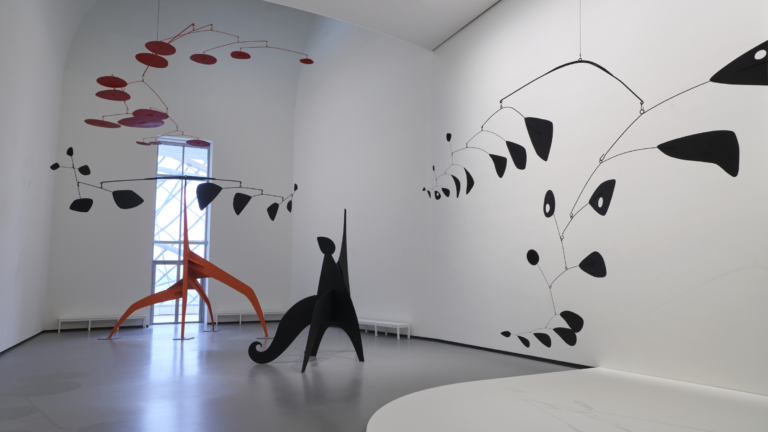
This radical proposition is newly foregrounded in the ambitious “Calder. Rêver en Equilibre” exhibition at Fondation Louis Vuitton, where approximately 300 works trace the arc of Calder’s practice across decades. The exhibition does more than survey a career; it reconstructs a philosophical shift. By assembling mobiles, stabiles, paintings, drawings, and wire portraits within a single curatorial frame, it reveals the coherence of Calder’s vision: an art that exists not as an object alone, but as a system of relations between movement, space, and perception.
Drawing in Space: The Line as a Living Force
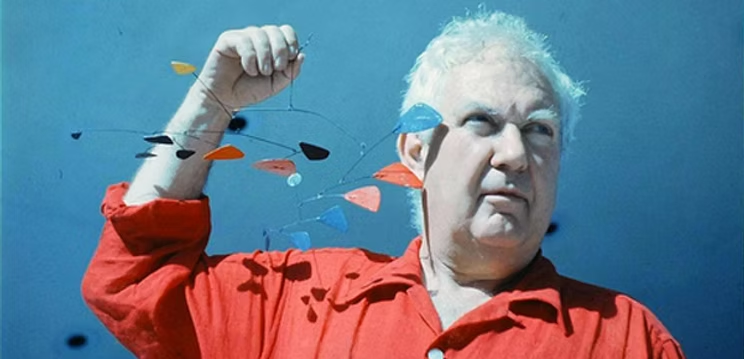
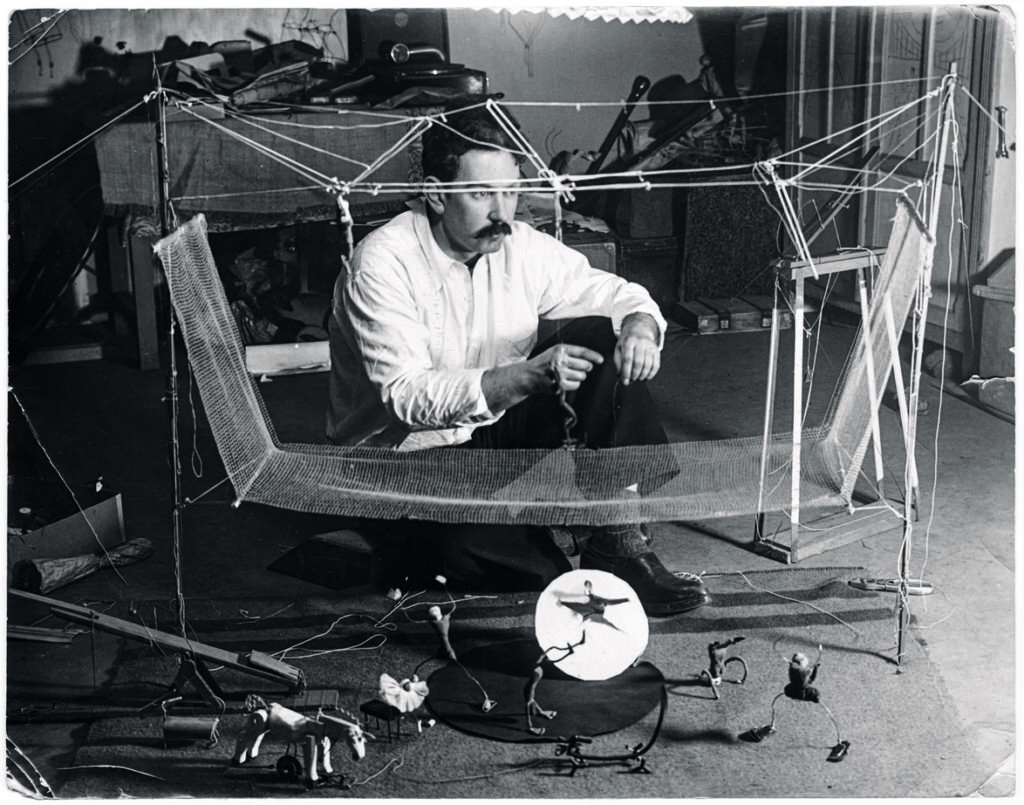
Calder’s early wire sculptures, often described as “drawings in space,” represent a crucial prelude to his kinetic innovations. These works did not simply extend drawing into three dimensions; they destabilized the hierarchy between line and mass. In traditional sculpture, volume asserts dominance, grounding the object in physical presence. Calder, by contrast, privileged linearity, allowing contours to hover, twist, and define form without enclosing it.
The fragility and wit of these pieces — many of them portraits or figures rendered with a few deft gestures — reveal an artist deeply attuned to the expressive capacity of minimal means. Yet beneath their apparent simplicity lies a profound conceptual shift. By reducing sculpture to line, Calder opened it to air, to void, and ultimately to movement. The wire works do not yet move in the manner of the mobiles, but they anticipate motion through their spatial openness and implied dynamism. They are, in essence, sculptures already thinking about becoming something else.
The Birth of the Mobile: Between Chance and Control
The transition from static wire constructions to suspended, moving forms marks one of the most consequential developments in modern sculpture. It is no coincidence that this transformation occurred in dialogue with the avant-garde milieu of Paris, where Calder encountered figures such as Piet Mondrian, whose abstract compositions suggested a universe structured by balance and rhythm. Calder absorbed these ideas but refused their stasis. Where Mondrian fixed equilibrium on the canvas, Calder sought to release it into the air.
The term “mobile,” famously coined by Marcel Duchamp, captures the dual nature of these works: they are both moving objects and agents of emotional mobility. Calder’s mobiles are governed by a delicate equilibrium of forces — gravity, weight, counterweight — but their behavior remains fundamentally unpredictable. A slight shift in air current produces a new configuration, a new composition, a new experience. In this sense, Calder relinquishes a degree of authorial control, allowing chance to collaborate in the creation of form.
This embrace of contingency aligns his work with broader philosophical currents of the 20th century, particularly those that question determinism and celebrate indeterminacy. Calder’s mobiles do not resolve into a single, ideal state; they exist as an ongoing series of transformations. Sculpture, in his hands, becomes temporal.
Time, Space, and the Expanded Field of Sculpture
To understand the depth of Calder’s innovation, one must consider how thoroughly he reconfigured the relationship between sculpture and time. Prior to his interventions, sculpture was largely conceived as an art of permanence. Even when depicting movement — as in the dynamism of Futurist forms — it remained materially fixed. Calder’s mobiles, by contrast, incorporate time as an essential dimension. They do not represent motion; they enact it.
This shift has profound implications for the viewer. Encountering a Calder mobile is not a matter of apprehending a stable object, but of entering into a durational experience. The work unfolds gradually, its forms aligning and dispersing in sequences that resist repetition. The viewer’s perception is thus extended, invited to linger, to observe, to attune to subtle variations. Sculpture becomes less about possession, of space, of form, and more about relation.
In this way, Calder anticipates what would later be described as the “expanded field” of sculpture, a term associated with Rosalind Krauss, an American art critic and theorist. Long before the theoretical articulation of this concept, Calder was already practicing a form of sculpture that exceeded its traditional boundaries, engaging environment, movement, and viewer participation as integral components.
Stabiles and Public Scale: Monumentality Reimagined
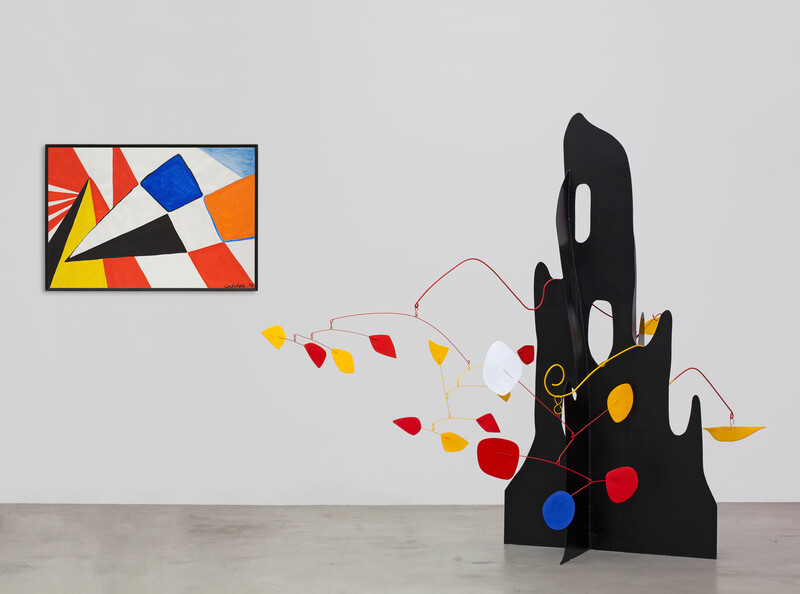
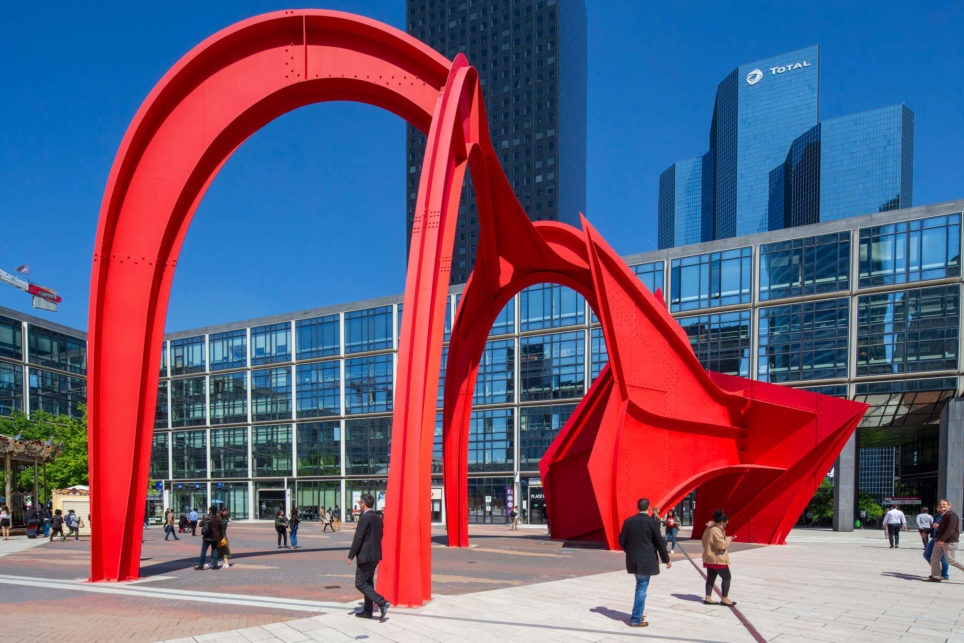
While the mobiles often command attention for their delicacy and motion, Calder’s stabiles — his large-scale, stationary sculptures — offer a counterpoint that is equally significant. These works, typically constructed from steel and often installed in public spaces, appear at first to return to the solidity of traditional sculpture. Yet they retain a sense of dynamism through their sweeping curves, angular planes, and implied movement.
In these monumental forms, Calder translates the principles of balance and tension into a different register. The stabiles do not move physically, but they evoke movement through their spatial relationships and structural daring. They engage architecture and landscape, redefining how sculpture inhabits public space. Rather than serving as inert monuments, they activate their surroundings, inviting viewers to navigate around and through them.
The coexistence of mobiles and stabiles within Calder’s oeuvre underscores the breadth of his inquiry. Movement, for Calder, is not confined to literal motion; it is a conceptual framework that informs both kinetic and static forms. His work suggests that even stillness can be charged with potential energy.
The Fondation Louis Vuitton Exhibition: A Total Vision
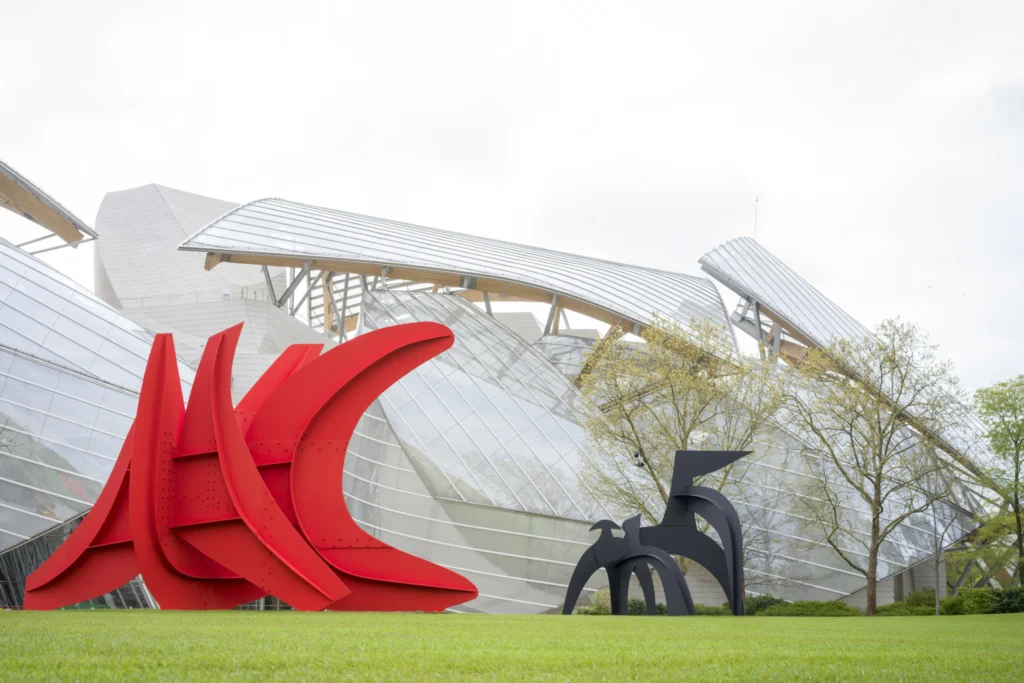
The exhibition “Calder. Rêver en Equilibre” at Fondation Louis Vuitton, on the centenary of Calder’s arrival in France and 50th anniversary of his death, offers an unprecedented opportunity to grasp the full scope of Calder’s achievement. By bringing together approximately 300 works across media and scale, it reveals the continuity of his exploration. The mobiles, often seen in isolation, are here contextualized alongside paintings that echo their color relationships, drawings that map their structural logic, and early wire pieces that foreshadow their spatial sensibility.
What emerges is not a fragmented career but a cohesive vision. Calder’s practice appears as a sustained investigation into the possibilities of form in motion, an inquiry that traverses mediums without losing its conceptual core. The exhibition also highlights the performative aspect of his work, as the movement of the mobiles activates the gallery space, transforming it into a dynamic environment rather than a static display.
For contemporary art viewers, artists, curators, collectors, the exhibition serves as both a historical reflection and a prompt for renewed consideration. It asks how we might understand sculpture today in light of Calder’s legacy, and how his insights continue to resonate within current practices.
Market Resonance: Innovation, Legacy, and Value
Calder’s transformation of sculpture has not remained confined to art historical discourse; it has also shaped the dynamics of the global art market. His works occupy a rare position at the intersection of innovation and accessibility. The visual clarity of his forms, combined with their conceptual depth, allows them to engage a wide spectrum of audiences while maintaining critical significance.
Over time, Calder’s mobiles and stabiles have become touchstones for collectors and institutions alike. Their presence in major museums reinforces their canonical status, while their continued demand at auction reflects a sustained confidence in their value. Yet to reduce Calder’s market success to mere financial metrics would be to overlook the deeper mechanisms at play. His work exemplifies how artistic innovation can generate enduring cultural capital, translating into both symbolic and economic value.
For art professionals, Calder offers a case study in how radical ideas can achieve long-term institutional and market validation. His legacy demonstrates that experimentation, when grounded in a coherent vision, can transcend its initial context and become foundational.
The Human Dimension of Movement
Despite the theoretical and historical weight of his contributions, Calder’s work retains a disarming sense of play. The notion that it “would be fun” to set forms in motion is not incidental; it is central to his practice. This playfulness does not diminish the seriousness of his achievement; rather, it humanizes it. It reminds us that innovation often begins with curiosity, with a willingness to explore without predetermined outcomes.
In the gentle oscillation of a mobile, one senses not only the forces of physics but also the presence of the artist — his intuition, his sensitivity to balance, his delight in unpredictability. Calder’s sculptures invite us to share in that sensibility, to experience art not as something fixed and distant, but as something alive and unfolding.
In redefining sculpture as an art of motion, Calder did more than expand a medium; he expanded our understanding of how art can exist in the world. His legacy continues to move — literally and metaphorically — through contemporary practice, reminding us that the most enduring forms are often those that remain open to change.