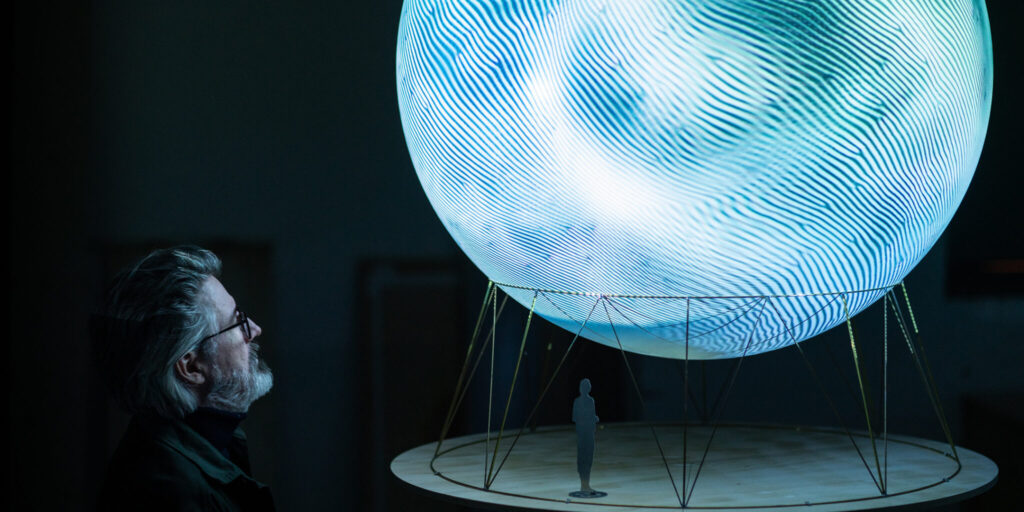
From March 26 through April 4, audiences in Salt Lake City in the U.S. are invited into a poetic encounter between sound, light, and ecological awareness. In A Symphony of Disappearing Sounds for the Great Salt Lake, Icelandic–Danish artist Olafur Eliasson presents a large-scale nighttime installation in the wooded landscape of Memory Grove Park.
Listening to a Vanishing Landscape
At the center of the work stands a monumental elevated sphere, illuminated after dusk by shifting light projections synchronized with an electronic musical composition. The soundscape is constructed from field recordings of wildlife and environmental phenomena drawn from the ecosystem of the Great Salt Lake. Some recordings originate from archival sources, while others were newly captured for the project, creating an acoustic portrait of a landscape under threat.
By relocating the sonic traces of the lake into an urban park, Eliasson transforms listening into an act of awareness. The installation invites visitors to encounter the fragile web connecting human life with the wider ecological world. Sounds that might otherwise remain distant — or gradually disappear — are brought into immediate sensory experience, revealing what is quietly slipping from perception as the lake’s ecosystem declines.
The work marks Eliasson’s first major project in the Intermountain West and serves as the culminating event of Wake the Great Salt Lake, a two-year program addressing the dramatic environmental changes affecting the lake. Organized through a collaboration between the Salt Lake City Arts Council, the Salt Lake City Mayor’s Office, and the Bloomberg Philanthropies Public Art Challenge, the initiative has commissioned a series of temporary works responding to the region’s ecological urgency. Alongside Eliasson’s installation, twelve additional projects by artists with ties to Utah have explored the cultural, environmental, and emotional dimensions of the lake’s uncertain future.
Within this context, A Symphony of Disappearing Sounds for the Great Salt Lake frames art as a space for collective listening. It is not merely an installation but a moment of shared perception — an invitation to reflect on what may soon be lost and what forms of awareness might still guide preservation.
Light, Atmosphere, and the Sculpting of Perception
Throughout his career, Eliasson has treated perception not simply as a response to art but as the very material of the artwork itself. Light, mist, reflection, and color become sculptural elements that shape how the body moves through space.
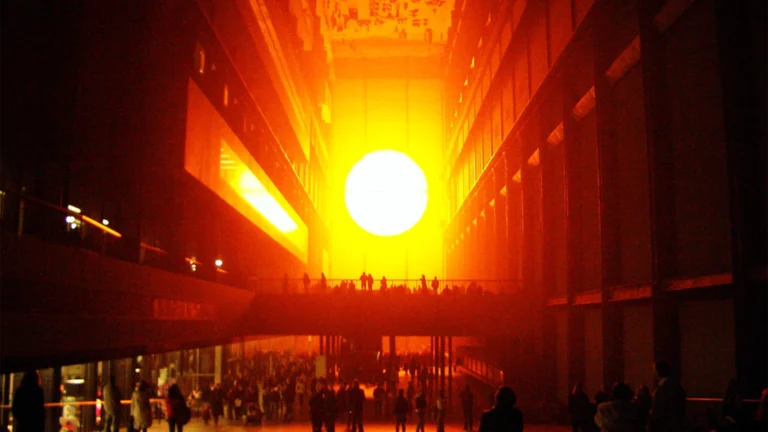
His landmark installation The Weather Project, presented in the London’s Turbine Hall of Tate Modern, remains one of the defining works of immersive installation art. A glowing artificial sun hovered within a vast atmospheric haze, its radiance mirrored by a reflective ceiling that doubled the illusion of scale. Visitors gathered beneath it as though under a celestial body, reclining on the floor or gazing upward in quiet contemplation.
The work demonstrated Eliasson’s remarkable ability to choreograph collective perception. The “sun” itself was technically simple — monochromatic lamps and mist — but the spatial orchestration produced an experience of shared wonder that blurred the boundary between natural phenomenon and constructed illusion.
Such installations recall the long art historical fascination with light as a metaphysical and emotional force. From the atmospheric luminosity of J. M. W. Turner to the perceptual environments of James Turrell, artists have sought to transform light into an experiential medium. Eliasson extends this lineage through contemporary technology and architectural scale.
Phenomenology and the Art of Awareness
At the philosophical core of Eliasson’s practice lies an engagement with phenomenology, the study of how humans experience the world through the body and the senses. Thinkers such as Maurice Merleau-Ponty argued that perception is not passive observation but an active, embodied process.
Eliasson’s installations operate precisely within this framework. Rather than presenting images to be viewed at a distance, he constructs environments that activate the viewer’s awareness of seeing itself.
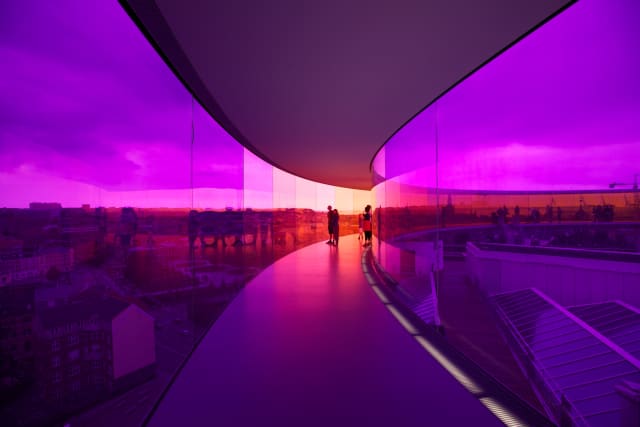
In works such as Your Rainbow Panorama, a circular glass walkway crowning the roof of the ARoS Aarhus Art Museum in Denmark, visitors move through a spectrum of colored glass that continuously reframes the surrounding cityscape. The artwork does not reside solely in the architectural structure but in the shifting perception of those walking through it.
The city becomes the image. The viewer becomes the instrument of perception.
Studio as Laboratory
Behind these immersive environments stands the collaborative structure of Studio Olafur Eliasson, an interdisciplinary workspace that operates as both studio and research laboratory. Architects, craftspeople, engineers, art historians, and scientists work together to develop projects that often require complex technical solutions and large-scale fabrication.
This model reflects a broader transformation in contemporary art practice. Increasingly, artists working with installation, environmental systems, and public space adopt collective modes of production that resemble research institutions or architectural studios.
Within this collaborative environment, material experimentation is constant. Optical devices, reflective surfaces, water systems, and atmospheric conditions are tested and refined until they achieve the desired perceptual effect. The studio’s approach underscores an important point: while Eliasson’s works often feel ephemeral or elemental, they are grounded in rigorous experimentation with physical processes.
Environmental Consciousness as Experience
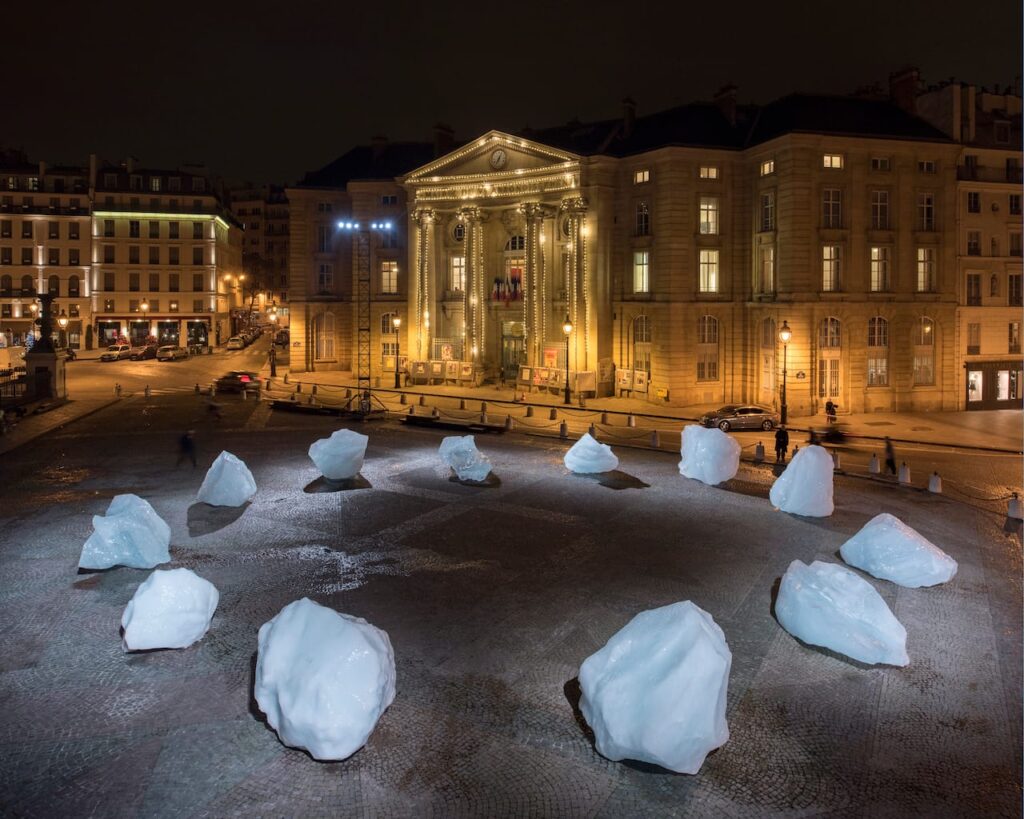
Eliasson’s work frequently connects sensory experience with environmental awareness. Projects such as Ice Watch, a collaboration project with geologist Minik Roising, brought massive blocks of glacial ice from Greenland to urban centers in Copenhagen, Paris, and London. Arranged in public squares, the slowly melting ice functioned simultaneously as sculpture and evidence — an immediate encounter with the material reality of climate change.
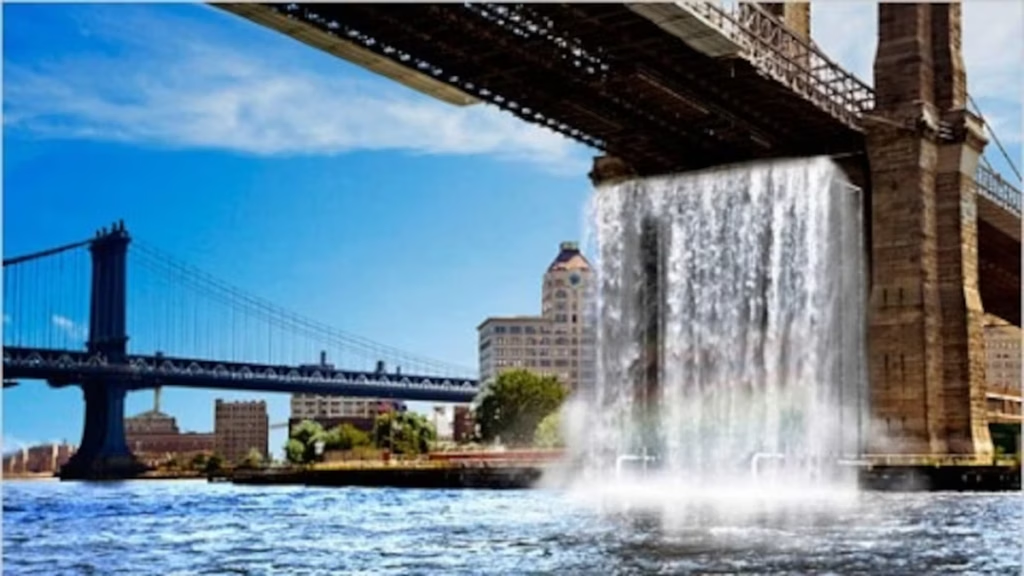
Similarly, his installation The New York City Waterfalls transformed the waterfronts of New York City into sites of monumental artificial cascades, reconnecting urban residents with the elemental presence of water within the city’s geography.
In each case, Eliasson avoids didactic messaging. Instead, he constructs experiential situations where environmental processes become sensorially present.
The goal is not simply to illustrate ecological crisis but to reshape how we perceive our relationship to the planet.
The Architecture of Experience
Ultimately, Eliasson’s installations reveal that architecture need not be defined solely by walls and structures. The atmosphere itself can be architectural. Light, sound, fog, reflection, and color become spatial tools capable of transforming how people inhabit a place.
In A Symphony of Disappearing Sounds for the Great Salt Lake, the glowing sphere and surrounding soundscape form a temporary architecture of listening. The park becomes an acoustic landscape where visitors move through layers of environmental memory.
For artists, curators, and exhibition designers, Eliasson’s practice offers a compelling proposition: the artwork is not the object but the experience constructed around it.
Perception becomes the medium. Space becomes the canvas. And the viewer becomes an active participant in the unfolding work.