When a Rothko Becomes More Than a Painting
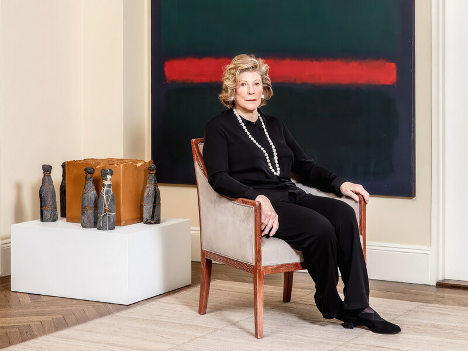
This spring, the market once again reminded the art world that Mark Rothko remains one of the defining figures of twentieth-century art. At Christie’s New York, No. 15 (Two Greens and Red Stripe) (1964), formerly owned by legendary patron and former Museum of Modern Art president emerita Agnes Gund, sold for a hammer price of $85 million — reaching $98.4 million with fees and establishing a new auction record for the artist.
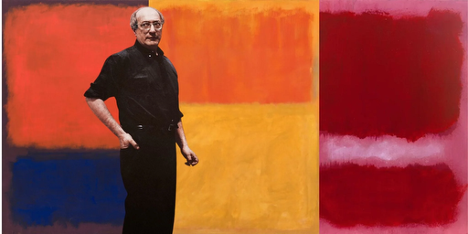
The sale was not merely another headline in the increasingly theatrical spectacle of the global art market. It revealed something more enduring: Rothko’s extraordinary ability to move between two worlds that rarely coexist comfortably — the contemplative and the commercial. His paintings continue to command reverence in museums while simultaneously operating as apex cultural assets within the uppermost tier of the art market.Yet reducing Rothko to auction numbers misses the deeper truth of his achievement. Few artists transformed the emotional possibilities of painting as radically as he did. His canvases are not simply “color fields.” They are environments of psychological intensity, meditations on mortality, silence, tragedy, intimacy, and transcendence. For artists, curators, and historians alike, Rothko remains central not because of market validation, but because he fundamentally altered how painting could be experienced.
Rothko Beyond Abstraction
To understand Rothko’s place in art history, one must move beyond the convenient label of Abstract Expressionism.
Although grouped alongside figures such as Jackson Pollock, Barnett Newman, and Clyfford Still, Rothko rejected the idea that his work was merely formal abstraction. He famously insisted:
“I’m interested only in expressing basic human emotions.”
That statement remains essential to understanding his work. Rothko did not abandon representation in pursuit of pure aesthetics; rather, he stripped painting down to its emotional and spiritual essentials. The floating rectangles that define his mature works are less compositional devices than vessels of human feeling.
His early career reveals this transformation gradually unfolding. In the 1930s and early 1940s, Rothko painted urban scenes and psychologically charged figures shaped by myth, Surrealism, and Nietzschean philosophy. By the late 1940s, however, figuration dissolved into hovering forms and luminous chromatic atmospheres. This evolution mirrored a larger postwar crisis in representation. After World War II and the trauma of the Holocaust, traditional image-making seemed inadequate for articulating existential anxiety.
Rothko’s answer was not narrative but presence.
In this sense, his work shares philosophical territory with modern spiritual architecture, music, and theater more than with conventional easel painting. Standing before a mature Rothko is not about decoding symbols. It is about entering a state of heightened perception.
Silence as Medium
Perhaps the most radical aspect of Rothko’s art is his use of silence.
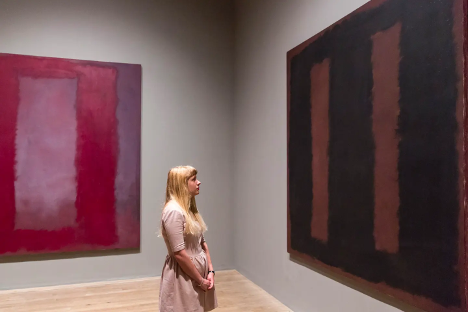
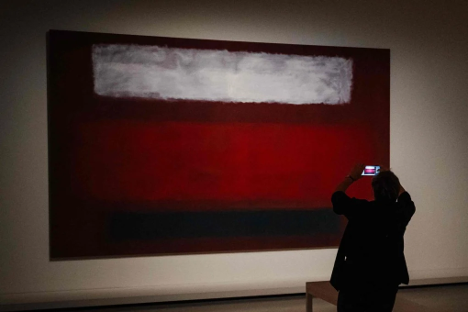
The paintings appear visually quiet, yet emotionally overwhelming. Their surfaces pulse softly, edges dissolve, and colors hover in unstable equilibrium. Unlike the aggressive physicality of Pollock’s drip paintings, Rothko’s canvases slow the viewer down. They require duration, stillness, and surrender.
This was intentional.
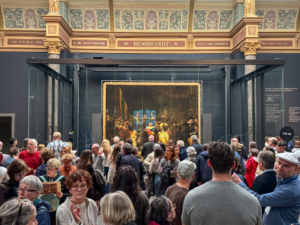
Rothko cared obsessively about installation conditions — lighting, hanging height, proximity, and even architectural enclosure. He wanted viewers to stand close enough that the paintings would fill peripheral vision and create an immersive encounter. The canvas ceased to function as an object on the wall and instead became an atmospheric field.
This ambition reached its fullest realization in the Rothko Chapel, completed shortly before the artist’s death in 1970. The chapel remains one of the twentieth century’s most profound intersections of art, architecture, and spirituality. Its dark, near-monochromatic paintings reject spectacle entirely, offering instead an environment of contemplation and existential gravity.
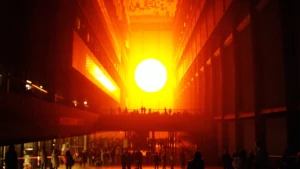
For many contemporary artists working today — particularly those engaged with installation, phenomenology, or meditative spatial practices — Rothko’s influence remains foundational. One sees echoes of his atmospheric thinking in the work of James Turrell, Olafur Eliasson, and Lee Ufan, all of whom explore perception as a bodily and spiritual experience rather than a purely visual event.
Scale and the Human Body
Rothko understood scale psychologically rather than monumentally.
His large canvases are often misunderstood as gestures of heroic masculinity associated with postwar American painting. In reality, Rothko used scale to create intimacy. The viewer does not look at the painting from a distance; one enters into a physical relationship with it.
This distinction is crucial.
The expansiveness of Rothko’s paintings dissolves conventional spatial boundaries between artwork and observer. The paintings become almost architectural — emotional chambers rather than images. This spatial sensitivity fundamentally changed curatorial practice in museums during the second half of the twentieth century. Entire galleries increasingly began to prioritize experiential viewing, controlled lighting, contemplative pacing, and spatial immersion.
In many ways, Rothko helped establish the contemporary museum experience itself.
His work also transformed expectations around duration and attention. Unlike highly narrative or image-dense contemporary visual culture, Rothko’s paintings resist instant consumption. Their emotional resonance unfolds slowly, often unpredictably. Many viewers report deeply personal reactions ranging from serenity to grief. Rothko himself welcomed this intensity, once remarking that people who wept before his paintings were having the same religious experience he had while painting them.
Rothko and the Sacred After Modernism
One of Rothko’s greatest achievements was reintroducing the possibility of the sacred into modern art without returning to religious illustration.
This is perhaps why his work continues to resonate so deeply in secular contemporary culture. Rothko understood that modern humanity still longed for transcendence, ritual, and metaphysical encounter — even after the collapse of traditional religious certainties.
His paintings create a kind of non-denominational spirituality.
The influence of Nietzsche, Greek tragedy, and existential philosophy remained central throughout Rothko’s life. Yet unlike many modernists who embraced irony or fragmentation, Rothko pursued emotional sincerity with extraordinary seriousness. He believed painting could still confront the largest human questions: death, ecstasy, isolation, fear, and transcendence.
This seriousness distinguishes Rothko from many contemporary market-driven tendencies toward spectacle or conceptual cleverness. His paintings demand vulnerability both from the artist and the viewer.
For curators and institutions, Rothko therefore occupies a unique position within the modern canon. He bridges formal modernism and spiritual experience; intellectual rigor and emotional immediacy; aesthetic refinement and universal human feeling.
The Market Mythology of Rothko
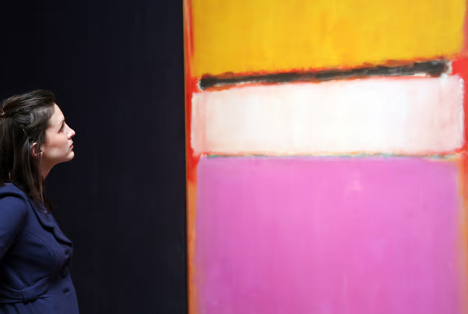
The recent Christie’s sale of Agnes Gund’s Rothko underscores how profoundly the market now mythologizes certain postwar artists.
Yet Rothko’s market strength is not driven by speculation alone. Several factors continue to sustain extraordinary demand:
1. Extreme Rarity
Museum collections hold many of Rothko’s greatest works, severely limiting supply. Major canvases from the 1950s and early 1960s rarely appear at auction.
2. Institutional Validation
Rothko’s presence within leading institutions — from Tate Modern to the National Gallery of Art and Museum of Modern Art — reinforces his canonical status globally.
3. Emotional Accessibility
Unlike highly theoretical conceptual art, Rothko’s work remains emotionally legible across cultures. Collectors often describe deeply personal relationships with the paintings.
4. Provenance and Patronage
The provenance of Agnes Gund amplified the recent Christie’s sale considerably. Gund herself embodied a form of ethical and intellectual collecting increasingly rare in today’s market landscape. Her long stewardship of the painting added historical and emotional gravity to the work’s market narrative.
At the same time, Rothko’s market exposes the paradoxes of contemporary art economics. Paintings originally intended as meditations on human vulnerability now circulate as symbols of extraordinary wealth. This tension is unavoidable — and perhaps inseparable from the modern canon itself.
Still, unlike many speculative market phenomena, Rothko’s critical importance long predates his auction success. The market followed the scholarship, not the reverse.
Rothko’s Continuing Relevance for Artists Today
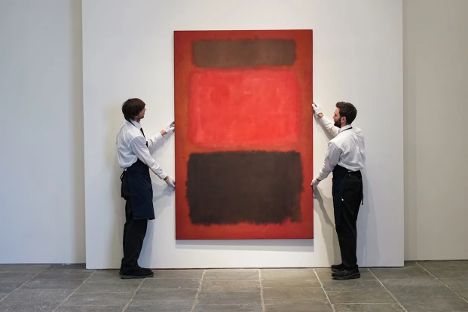
For younger artists, Rothko remains instructive not because his style should be imitated, but because of the seriousness of his artistic pursuit.
He reminds contemporary practitioners that painting can still aspire toward emotional and philosophical depth without surrendering to illustration or spectacle. His work argues for slowness in an accelerated culture, contemplation in a distracted one.
His influence persists not only in abstraction but also in installation art, minimalism, spatial practices, and even cinema. Filmmakers, composers, architects, and designers continue to draw from Rothko’s orchestration of mood, silence, and atmosphere.
Importantly, Rothko also demonstrates that emotional sincerity need not be naive. His paintings are intellectually rigorous precisely because they confront feelings directly.
That achievement remains rare.
Why Rothko Endures
More than fifty years after his death, Mark Rothko continues to occupy a singular position in modern art history.
His paintings resist easy reproduction in digital culture because their true power exists in physical encounters. They demand presence, duration, and emotional openness. In an era increasingly dominated by velocity, image saturation, and spectacle, Rothko’s work offers something almost radical: stillness.
Christie’s recent record confirms the market’s continuing faith in Rothko. But the deeper reason for his endurance lies elsewhere.
Rothko changed the role of painting itself. He transformed the canvas from a surface of depiction into a site of existential experience.
Few artists can claim as much.