There is a moment, in almost every museum visit, when a velvet rope or a closed door reminds you that something important is happening just out of sight. For most of the history of conservation, that “something” was the cleaning, repair, and study of paintings — a discipline practiced in windowless basements by specialists who rarely spoke to the public and almost never let the public watch. That arrangement has started to crack. At the Musée d’Orsay, the Rijksmuseum, and the Royal Museum of Fine Arts Antwerp, restoration has moved out of the back room and into the gallery, behind walls of glass instead of locked doors, with conservators working in full view of ticket-holders who come specifically to watch paint being cleaned.
The question worth asking is not simply whether this is a good idea, but when and why restoration stopped being a backstage activity and became part of the exhibition itself.
The Cult of the Hidden Hand
For most of the twentieth century, conservation operated on a principle close to medical confidentiality: the patient’s treatment was nobody’s business but the doctor’s. Museums had practical reasons for this. Revealing how a painting was altered, retouched, or structurally repaired could undercut the aura of authenticity that museums depend on to justify ticket prices, insurance valuations, and scholarly authority. There was also a guild-like culture within conservation itself, a discipline that emerged from craft traditions and was, for decades, more comfortable being judged by other specialists than by the public. The result was an unspoken agreement: visitors saw finished masterpieces, never works in progress, and the labor that kept those masterpieces presentable was treated as a kind of professional secret.
This secrecy was never absolute — conservation journals and academic conferences have long published treatment reports — but it was almost entirely closed to lay audiences. A painting would disappear from the wall, a label would say it was “undergoing conservation,” and it would reappear months or years later looking cleaner, with no public record of what had happened in between.
Glass Walls and Open Books
What changed was less about conservation technique than about what audiences began to expect from institutions generally. As trust in expert authority eroded across many fields in the twenty-first century, museums faced the same pressure that hit governments, scientific bodies, and media organizations: show your work, or risk being accused of hiding something. A painting that vanishes for restoration and returns transformed invites a question that didn’t used to get asked very often — what exactly did you do to it, and how do we know it was right?
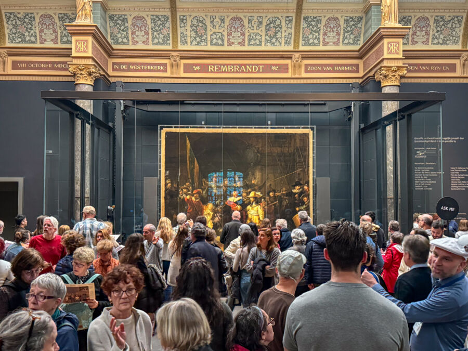
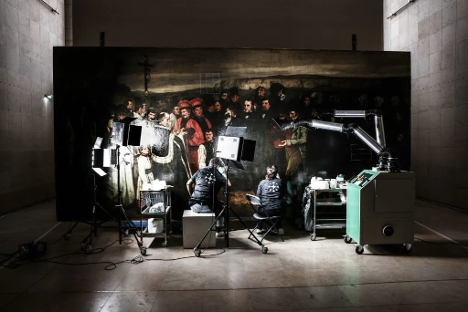
Public restoration projects answer that question by removing the gap between claim and evidence. When the Rijksmuseum launched what it called the most extensive investigation ever undertaken into Rembrandt’s masterpiece, the museum didn’t just promise rigor — it enclosed the painting in a purpose-built glass room so visitors could watch the work unfold, and streamed the process online so anyone, anywhere, could follow along. The Musée d’Orsay applies the same logic to Courbet’s monumental canvas, restoring it behind a custom viewing window built specifically so visitors can look in on conservators as they work. Transparency, in this sense, has become a substitute for the trust that used to be taken for granted.
The Attention Economy Enters the Lab
Transparency alone doesn’t fully explain the trend, because transparency could be achieved quietly — a published technical report, a behind-the-scenes video, a wall label with more detail. What public restoration adds is spectacle, and museums have clear incentives to want it. Institutions are competing for a shrinking pool of attention against everything else a smartphone can offer, and a painting being cleaned in real time, with conservators wielding scalpels and cotton swabs a few feet from the crowd, is a far more compelling draw than another gallery of static labels. The Musée d’Orsay’s restoration of A Burial at Ornans has turned conservation into a recurring tourist event, drawing steady crowds who linger at the glass, phones raised, to watch the work in progress. One visiting art historian noted that the format’s real appeal lies in repeat viewing — letting the public return again and again over the course of a months-long treatment, more like checking in on a renovation than viewing a finished artwork.
This is also, notably, not the Orsay’s first experiment with the format: the museum had restored Courbet’s The Painter’s Studio under similar conditions roughly a decade earlier, suggesting that what began as a one-off curatorial gamble has become a repeatable institutional strategy.
The Conservator as Cultural Authority
One of the more interesting side effects of all this glass is that conservators themselves have become public figures in a way they rarely were before. Restoration used to credit the museum or, at most, a department; now individual conservators are named, photographed, and quoted, their hands and tools becoming part of the spectacle. At the Rijksmuseum, director Taco Dibbits described the experience of varnish removal in strikingly intimate, almost theatrical terms, telling press that visitors would be able to see the painting “in a sense, naked, without makeup.” At KMSKA in Antwerp, individual restorers working on the Rubens altarpiece — among them Jantine Maessens, Jill Keppens, and Kayla Metelenis — have been photographed by wire services at work on the canvas, their names and faces now part of the documentary record of the painting itself.
This shift matters because it changes who gets to speak with authority about a painting’s condition and meaning. Curators and art historians have traditionally held that role; now conservators — whose expertise is technical and material rather than purely historical — are increasingly the ones narrating a masterpiece’s story to the public, in real time, with the evidence visible behind them.
The Studio as Stage
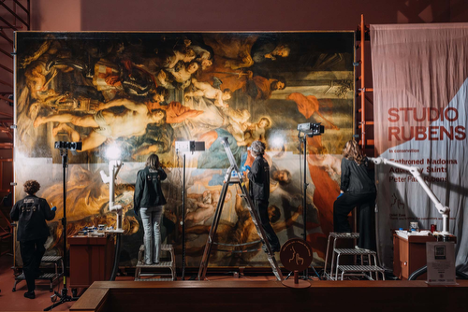
The architecture of these projects gives away how deliberately theatrical they are. These are not simply roped-off work areas; they are purpose-built structures designed for viewing. For The Night Watch, the Rijksmuseum brought in French architect Jean Michel Wilmotte to design a near-invisible glass enclosure, treating the restoration room itself as a piece of museum architecture rather than a temporary workaround. The Musée d’Orsay took a similarly hands-on approach for A Burial at Ornans, having its own in-house carpentry and metalworking teams build the plexiglass viewing structure — produced with the same institutional craftsmanship the museum would apply to mounting a major exhibition. At KMSKA, the scale of the Rubens altarpiece required something closer to a stage set than a studio: a temporary structure nicknamed “Studio Rubens,” occupying roughly a quarter of the museum’s expansive Rubens Gallery, complete with scaffolding engineered specifically to let restorers work at height on the gigantic canvas while remaining visible to visitors below.
When a museum invests this much design and engineering into a temporary structure meant to disappear once the work is finished, it is making a statement: conservation is no longer ancillary to the visitor experience. It is the exhibition.
Four Rooms, Four Reveals
Operation Night Watch — Rijksmuseum, Amsterdam
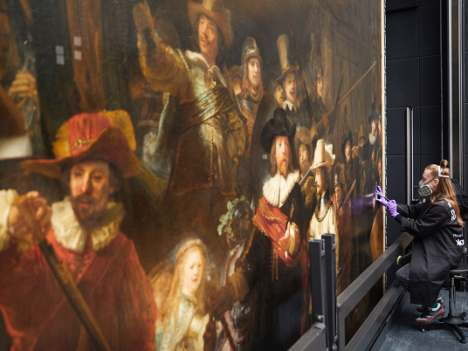
Rembrandt’s 1642 militia portrait is arguably the project that brought public restoration to global attention. Launched in July 2019, Operation Night Watch was billed by the Rijksmuseum as the most extensive investigation ever undertaken into the painting, opening with five years of imaging and material analysis before any physical treatment began. The museum erected a large glass chamber around the canvas so visitors could watch the work unfold, and the project drew on an unusually wide consortium of partners, from chemical company AkzoNobel to the Cultural Heritage Agency of the Netherlands, Delft University of Technology, the University of Amsterdam, and the National Gallery of Art in Washington. The project to restore The Night Watch in its original form also produced one of conservation’s most striking public moments: using artificial intelligence together with a seventeenth-century copy of the composition, researchers reconstructed the strips that had been trimmed from the canvas centuries earlier, briefly letting visitors view the painting at something close to its original scale, an effect not seen in three hundred years. By late 2024, conservators had moved on to the more delicate work of removing old varnish, with the museum’s director noting that earlier interventions had been rushed by necessity, whereas this one was deliberately allowed to proceed slowly and in the open.
A Burial at Ornans — Musée d’Orsay, Paris
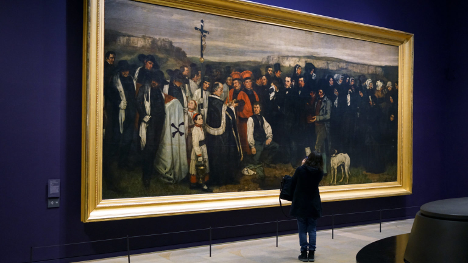
Courbet’s monumental, deliberately unglamorous funeral scene — a painting that scandalized the Paris Salon of 1850–51 precisely because it treated ordinary villagers with the gravity once reserved for history painting — is now itself the subject of a very public second act. The painting had gone without significant restoration for at least half a century before the Orsay enclosed it in a viewing structure in 2025, where a team of seven restorers has been cleaning aged varnish and consolidating the canvas’s structure. The restoration of the painting A Burial at Ornans follows a 2020 technical examination that turned up its own quiet revelation: an X-ray scan showed that a strip of the original canvas, several centimetres wide, had been folded under the frame at some point — most likely not long after the painting joined the national collection in the 1880s — subtly compressing the composition for well over a century without anyone realizing it.
Enthroned Madonna Adored by Saints — Royal Museum of Fine Arts Antwerp (KMSKA)
Rubens’s altarpiece, painted around 1628 for the high altar of Antwerp’s Augustinian Church, presented a problem public restoration projects don’t usually have to solve: the painting was too large to move to a conservation lab at all. KMSKA’s solution was to bring the lab to the painting, building “Studio Rubens” directly inside the Rubens Gallery so that visitors could watch the restoration from a distance over the two years the project took. Beyond cleaning, the project used macro-XRF scanning to study Rubens’s working method, and the findings overturned a long-standing assumption about his studio practice: rather than Rubens sketching ideas for assistants to execute, the evidence suggested some preparatory studies were likely made by staff, while Rubens himself painted most of the final altarpiece. KMSKA has already moved on to the next chapter of the same public format, restoring Rubens’s Adoration of the Magi in view of visitors, timed to be completed for the 450th anniversary of the painter’s birth in 2027.
Girl with a Pearl Earring — Mauritshuis, The Hague
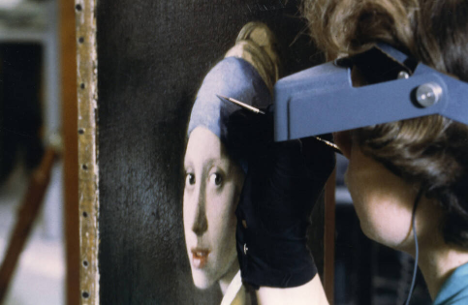
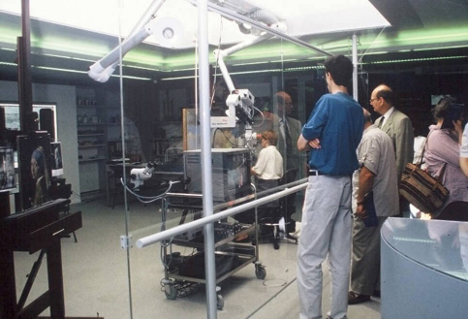
If public restoration feels like a recent phenomenon, the Mauritshuis offers a useful corrective: it has been doing some version of this since 1994. When Vermeer’s Girl with a Pearl Earring was restored ahead of a blockbuster exhibition that year, in a project called Vermeer Illuminated, visitors could watch the conservators at work from two vantage points — through a glass wall and from a skylight overhead — in what is now considered one of the earliest deliberate efforts to let the public witness a painting being restored. In 2018, the museum repeated the format for a different kind of project: not a restoration, since none was needed, but a two-week, round-the-clock technical examination called The Girl in the Spotlight, conducted in a purpose-built glass studio in the museum’s Golden Room with scientists from the Rijksmuseum, TU Delft, the University of Antwerp, and the National Gallery of Art in Washington. The research yielded a genuinely new art-historical fact, the kind that public conservation projects increasingly seem to produce as a byproduct of their visibility: Vermeer originally set his sitter against a plain green curtain rather than the dark, undefined background visible in the painting today.
What’s Gained, and What’s Risked
It would be too easy to treat public restoration purely as a marketing innovation, and too easy to treat it purely as an ethical triumph of transparency. Both readings are partly true. On one hand, these projects genuinely democratize a body of knowledge that used to be the exclusive property of a handful of specialists, and they have repeatedly produced real scholarship — overturned assumptions about Rubens’s studio, recovered information about Vermeer’s lost curtain, evidence of how Courbet’s canvas was physically altered after his death. On the other hand, turning conservation into spectacle creates new pressures of its own. A restoration performed in public is, to some degree, a restoration performed for an audience, and institutions will have to keep asking honest questions about whether visibility changes the pace of decision-making, the willingness to pause and reconsider a treatment, or the temptation to prioritize visually dramatic interventions over conservative, minimal ones. Transparency is not the same thing as scrutiny; a glass wall lets people watch a process, but it doesn’t necessarily let them evaluate it.
What seems clear is that the backstage/front-of-house distinction that used to define how museums presented themselves is dissolving, and not only in conservation. Museums increasingly understand themselves not as static custodians of finished objects but as live institutions whose ongoing labor — research, debate, even uncertainty — is itself something audiences want access to. Restoration on display is one of the more vivid expressions of that shift: proof that even four-hundred-year-old paintings have something left to say about how an institution chooses to be watched.