This October, the Whitney Museum of American Art opens Roy Lichtenstein: Like New, a survey bringing together roughly 130 works spanning six decades, from student paintings of the early 1940s through the artist’s final canvases of the 1990s. Among its most anticipated moments is the reconstruction of Lichtenstein’s landmark 1962 debut at Leo Castelli Gallery — all eight original paintings reunited in one room for the first time since that exhibition made him a lightning rod of American art criticism. The show’s premise, as the museum has framed it, is not another rehearsal of Lichtenstein’s comic-panel period. It is an argument that his entire career was a sustained inquiry into how images are built, copied, circulated, and made to feel new again.
Roy Lichtenstein’s Continuing Market Strength
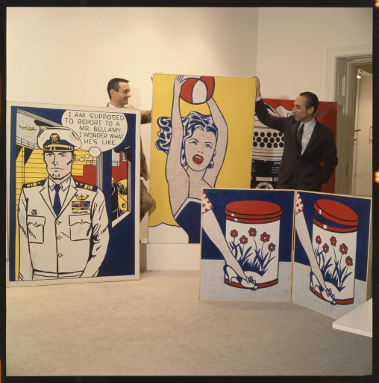
The timing could hardly be more pointed. The art market has spent the past year reminding everyone why Lichtenstein remains one of the twentieth century’s most closely watched painters at auction. His record price still stands at $95.4 million, set in 2015 for Nurse (1964) at Christie’s New York. This past spring, a long-unseen painting from his “Girl” series, Anxious Girl (1964), resurfaced after decades in private hands and sold for just over $46 million at Christie’s, immediately becoming a new entry in the artist’s top ten public sales. A year earlier, more than ninety works from Lichtenstein’s own estate — held by his widow, Dorothy, until her death — realized $27 million at Sotheby’s, nearly double the presale estimate, with buyers competing hardest for pieces that carried the weight of direct provenance. Taken together, a museum retrospective built around the instability of images and an auction market still hungry for authenticated Lichtensteins make an unlikely but instructive pairing: both are, in their own ways, about what happens when an image is certified as original.
More Than a Pop Art Icon
For an audience already fluent in Lichtenstein’s biography — the Rutgers professor turned Pop icon, the projector and grid, the Ben-Day dots stenciled through a perforated screen — the more interesting question isn’t what he painted. It’s what his method was actually an argument for. Scholarship on Lichtenstein has increasingly converged on a claim that sounds almost paradoxical: this was an artist who used the most mechanical-looking process in postwar American painting to ask some of the most sophisticated questions about perception, representation, and authorship that Pop art ever posed.
Beyond the Panel: What the “Comic Book Painter” Label Obscures
The shorthand version of Lichtenstein — appropriator of DC and romance comics, popularizer of the dot, punchline to Abstract Expressionism’s seriousness — has always been true enough to be useful and thin enough to be misleading. It explains the surface. It doesn’t explain why art historians keep returning to his work with the same intensity that once greeted his contemporaries’ more overtly conceptual practices.
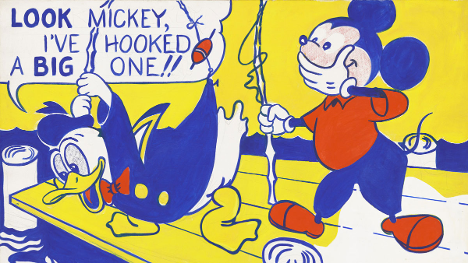
The more productive frame, and the one the Whitney exhibition leans into, treats Lichtenstein’s comic-derived paintings of the early 1960s as a single, tightly bounded phase in a much longer investigation. Before Look Mickey (1961), he had spent over a decade cycling through Cubism, Abstract Expressionism, and folk-inflected Americana, never quite settling. After the comic paintings made him famous, he spent the next three decades applying the same interrogative method to an ever-widening set of subjects: Cézanne compositions rebuilt in dots, Picasso quotations flattened into commercial line, Art Deco motifs, brushstroke paintings that mocked gestural sincerity, mirrors, interiors, nudes, and finally the “Reflections” series, in which a diagonal band of white implies a sheet of glare-obscured glass sitting between the viewer and the image — a picture about the difficulty of seeing a picture.
The Comic Book as a Visual Laboratory
What holds this range together isn’t subject matter. It’s a consistent set of operations: translate a source image into a limited vocabulary of flat color, heavy contour, and mechanical dot patterning, and in doing so expose the conventions by which that image originally persuaded a viewer of its realism. The comic panel was simply the first and most legible test case, because comic printing already relied on a crude reproduction technology — offset lithography, cheap paper, low-resolution dot screens — that Lichtenstein could isolate, enlarge, and hand-paint with obsessive precision. The dots were never really about comics. They were about making visible the mechanism by which mass reproduction manufactures the illusion of a coherent image.
The Hand That Imitates the Machine
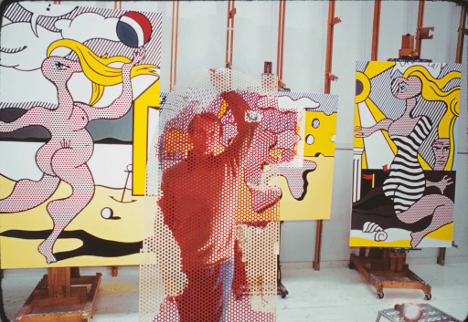
Few paradoxes in postwar painting are as productive as this one: Lichtenstein’s canvases look mass-produced and are not. Every dot in his early and mid-career work was painted or stenciled by hand, often through a perforated metal screen, with corrections and touch-ups made individually. The compositions were frequently projected and traced, then adjusted through dozens of preparatory drawings before a single stroke of paint was applied to canvas. This is, in other words, an artisanal process pretending to be an industrial one — the opposite of what a casual viewer assumes when they see the dots.
This inversion matters because it undercuts one of Pop art’s more comfortable clichés: the idea that Pop simply held up a mirror to consumer culture, presenting mass-produced imagery neutrally, without transformation. Lichtenstein’s practice argues otherwise. By painstakingly reconstructing the visual grammar of cheap reproduction at a scale and material permanence no printing press could achieve, he wasn’t flattening high and low culture into equivalence. He was staging a confrontation between two different regimes of image-making — the industrial and the painterly — and asking viewers to notice that they could no longer tell, at a glance, which one they were looking at.
Originality Through Imitation
This is also where the “authenticity” question in Lichtenstein scholarship gets interesting. A hand-painted simulation of a mechanically reproduced image scrambles the usual hierarchy in which the unique, handmade object is assumed to carry more aesthetic and market value than its printed source. Lichtenstein’s paintings ask what “originality” even means when the entire visual content of the work was borrowed, and the labor invested went not into invention but into faithful, magnified imitation of someone else’s drawing — often an anonymous commercial illustrator’s.
Roy Lichtenstein and the Debate Over Appropriation Art
It’s worth remembering that when Lichtenstein began painting directly from comic panels and advertisements in 1961, there was no critical vocabulary yet for what he was doing. “Appropriation art” as a recognized category wouldn’t be theorized until the following decade, largely in response to artists like Sherrie Levine and Richard Prince. Lichtenstein predates that framework and before appropriation became an art movement, which is part of why his early reception was so hostile — critics genuinely didn’t have the conceptual tools to distinguish “copying” from “critique,” and many assumed the former.
Did Roy Lichtenstein Copy Comic Books?
The specific sources matter here. Lichtenstein worked from identifiable comic artists — among them Tony Abruzzo, Jerry Grandenetti, and other DC and romance-comic illustrators whose names appeared nowhere on the finished paintings. He rarely reproduced a panel without altering it: cropping, recomposing, changing dialogue, adjusting color relationships, or combining elements from more than one source. These were not tracings in any straightforward sense; they were edited translations. But the fact that the underlying image, character, and emotional register belonged to someone else’s labor — labor rendered invisible the moment it entered a gallery under Lichtenstein’s name — is precisely what later scholarship has had to sit with. Writers examining his work now tend to treat this less as a moral question about theft and more as the substance of the work itself: Lichtenstein made authorship the subject, not just the method. The paintings dramatize the fact that an image’s meaning and value can be entirely reassigned by the frame, the institution, and the signature attached to it, independent of who actually drew the lines first.
Why Authorship Became the Subject
This is also why the Whitney Museum’s decision to foreground image circulation and duplication as curatorial themes feels less like a repositioning than a correction. Reading Lichtenstein primarily as a chronicler of comic-book nostalgia was always a category error. He was closer to a media theorist working in oil and Magna paint, decades before that kind of practice had an academic home.
Perception as Subject Matter, Changing the Way We See Images
Lichtenstein’s engagement with perception runs deeper than the appropriation question, and it’s arguably the more art-historically load-bearing of the two. His paintings consistently stage the conditions under which an image is legible as an image — the minimum information a viewer’s eye needs to read a pattern of dots as a face, a cloud as a plausible cloud, a few curved lines as a wave.
Gestalt Psychology and the Ben-Day Dot
This is not incidental formalism. It draws, whether directly or by cultural osmosis, on mid-century interest in Gestalt psychology and the study of visual perception — the idea that the mind actively completes and organizes fragmentary sensory information into coherent wholes. Lichtenstein’s dot fields work exactly on this principle: from a distance, they cohere into shading and volume; up close, they dissolve into a mechanical grid of identical marks with no illusionistic content at all. The viewer’s own perceptual apparatus is implicated in producing the illusion. Lichtenstein isn’t just depicting a woman crying or a fighter jet firing a missile — he’s staging the precise threshold at which raw marks become a recognizable representation, and inviting the viewer to notice themselves crossing it.
The Brushstroke and Reflections Series
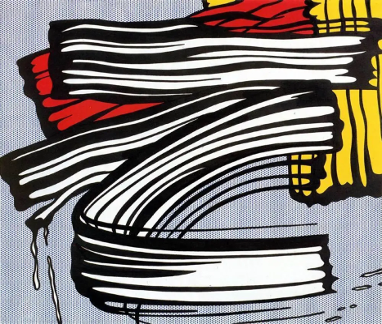
His later “Brushstroke” paintings push this further by turning the mechanism against itself. A gestural swipe of paint — historically the visual signature of authentic, spontaneous artistic feeling in Abstract Expressionist criticism — gets rendered as a hard-edged, flatly colored, cartoon version of a brushstroke, dripping in stiff, contour-lined rivulets that could never physically occur. The “Reflections” series does something structurally similar with a different target: it interposes a diagonal band suggesting glass and glare directly over famous compositions (including some of his own earlier paintings), so the viewer is denied full visual access to the image and made newly aware of looking through a surface rather than at a transparent window onto a scene. Both series make the same underlying point in different registers: every visual convention we read as “natural” — gestural authenticity, unobstructed representational clarity — is a learned code, and codes can be counterfeited, quoted, and exposed as codes.
The Whitney Museum Exhibition and Roy Lichtenstein’s Market Legacy
It’s worth being precise about why the Whitney Museum’s framing matters for how this body of work gets read going forward. Institutional narratives shape scholarly attention, and a retrospective built explicitly around duplication, circulation, and instability sets different terms than one built around “Pop art’s greatest hits.” Reconstructing the eight 1962 Castelli paintings as a discrete room does more than offer nostalgia for a famous opening; it lets viewers experience Lichtenstein’s earliest and most controversial claims about appropriation and reproduction in something close to their original sequence and scale, before market mythology and decades of merchandising flattened them into instantly recognizable “content” in their own right — tote bags, mugs, and phone cases included.
Authenticity, Provenance, and the Art Market
There’s a productive irony in the fact that an artist whose work relentlessly interrogated the mechanics of mass reproduction has himself become one of the most reproduced image-sources in contemporary visual culture, endlessly recirculated as decor, meme, and merchandise, largely stripped of the critical apparatus that made the originals significant. The recent run of high-value sales — a rediscovered “Girl” painting reentering the market after thirty years in private hands, an estate sale drawing intense competition for pieces with direct provenance to the artist’s own household — reflects a market that still cares, quite specifically, about authenticity of source: which hand touched this canvas, whose collection held it, how unbroken its chain of custody has been. That is the market performing, almost too literally, the very anxiety Lichtenstein’s paintings were built to provoke. An image’s value depends heavily on certified origin, even when — especially when — the image itself is a meditation on how easily origin can be obscured, borrowed, or faked.
Why Roy Lichtenstein’s Art Feels More Relevant Than Ever
Lichtenstein’s central preoccupations — that images are constructed rather than transparent, that reproduction technologies shape what we’re able to perceive as “real,” that authorship is a socially assigned status rather than a simple fact of who drew first — map with unusual precision onto contemporary anxieties around digital images, algorithmic generation, and the increasingly porous line between original and copy. A painting built from the visible seams of 1960s offset printing speaks, almost accidentally, to images in the digital age — a moment defined by upscaling artifacts, compression, and machine-generated imagery whose “authorship” is a genuinely contested legal and philosophical category.
Originality in the Age of AI
This is not a claim that Lichtenstein anticipated the internet, or that his dots are secretly about pixels. It’s a more modest and more defensible claim: he built a body of work whose core subject — the constructedness of images, and the instability of the line between original and reproduction — happens to be one of the defining preoccupations of contemporary visual culture. That’s a large part of why a museum can stage a 130-work retrospective in 2026 and describe it, credibly, as urgent rather than nostalgic.
The Illusion That Doesn’t Fade
The persistent temptation with Lichtenstein is to let the dots do all the talking — to treat the Ben-Day screen as a stylistic signature rather than an argument. What the Whitney’s exhibition, and the sustained market interest surrounding it, both suggest is that the argument was always the point. Lichtenstein didn’t merely borrow imagery from comics and advertising; he built a five-decade case study in how any image — however humble its source, however mechanical its apparent origin — becomes meaningful only through the specific, contingent, and ultimately fragile conventions by which we agree to read it as real. That is a much harder thing to reproduce on a tote bag. It’s also, arguably, the reason the paintings have kept their claim on serious attention long after the comic-book controversy that first made them famous has faded into art-historical footnote.