A dissident’s blunt verdict on his own profession, delivered beside a field of iron helmets on Sydney Harbor, asks something of everyone who makes, buys or legitimises art.
The Lawn and the Postcard
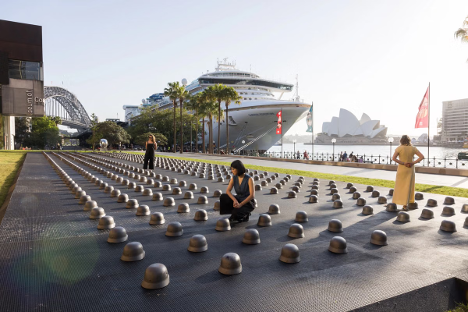
Some sites do half an artist’s work for them. The Tallawoladah Lawn at Sydney’s Museum of Contemporary Art faces the harbor and the Opera House, a view so familiar that it functions as civic advertising. Anything placed there must compete with a postcard.
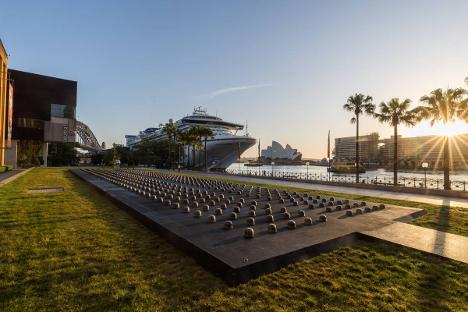
On 25 September, Ai Weiwei unveiled Mushrooms, a work of 500 cast-iron combat helmets set in ten uniform rows, as the new Neil Balnaves Tallawoladah Lawn Commission outside the museum, where it will stay on view for seven months, as The Art Newspaper reported. The work arrives with a sentence now travelling through the Australian press. An interview published online, with Ai Weiwei speaking from his farm in Portugal, carries the headline “90% of art is just garbage. Real art questions the existing order.”
The sentence invites an easy response, which is to bristle or to nod and move on. It deserves better, because it is addressed to a particular audience: the artists who decide what to make, the collectors who decide what to keep, and the curators, dealers and critics who decide what the public sees. If real art questions the existing order and most of what circulates does not, the verdict applies to all of them. It applies, too, to anyone tempted to treat a famous dissident’s candour as a pleasant frisson at the opening.
What the Sentence Claims
Start with what the sentence is. It is an interview remark, compressed by a headline, and “90%” is no measurement. It is a rhetorical number, the kind a person uses to say most without apology. Taking it literally invites the obvious retort that any rule condemning most of what exists flatters whoever applies it.
The sentence nonetheless contains two separable claims. The first is a negative judgment, that most art is garbage, and this is the part that travels. The second is a positive criterion, that real art questions the existing order, and this is the part that matters, because it supplies a standard. Garbage, on this account, is not defined by skill, medium, price or even sincerity. It is defined by function. Work that confirms the existing order, decorates it, or makes no demand upon it fails the test however well it is made.
In the interview as reproduced online, Ai Weiwei separates art from the depiction of beauty, describing it as a questioning of settled judgments in politics, in personal relationships and in individual thinking, and he adds that this kind of art is never encouraged. The same interview, in the excerpt we could read, suggests that people expect an artist to behave and be agreeable. That is the sharpest observation in the piece, because it turns the verdict from a complaint about quality into a complaint about incentives. If questioning art is not encouraged, the question for every institution and market is what it is encouraging instead.
A Career in Refusal
Before applying Ai Weiwei’s standard to everyone else, it is fair to ask how he has applied it to himself. A rough survey of his career shows a single move repeated at increasing scale: take what systems have consigned to the margins and make it impossible to ignore.
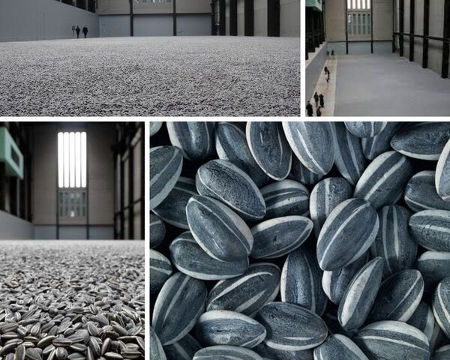
The early work questions objects and the values attached to them. A decade in New York in the 1980s exposed him to Duchamp’s readymade and Warhol’s treatment of fame as material, a kinship later made explicit when the National Gallery of Victoria staged a major exhibition pairing Warhol and Ai Weiwei. The lesson he drew was that an artwork’s context is part of what it is made of. His 1995 Dropping a Han Dynasty Urn triptych of dropping a Han dynasty urn is a small, quiet version of the 90% sentence, because it asks what exactly we are protecting and who decided it was sacred. The scale then grows. In 2010 his Sunflower Seeds filled the Turbine Hall of Tate Modern in London with a hundred million handcrafted porcelain seeds, converting mass production and individuality into a single argument, in a form the public loved. Questioning art, the work showed, need not be unpopular.
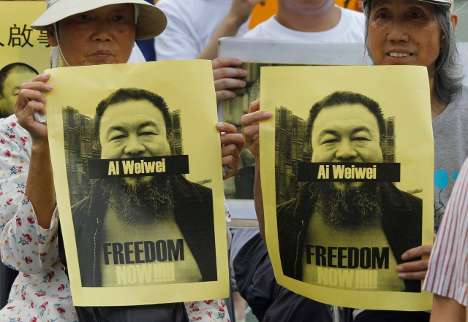
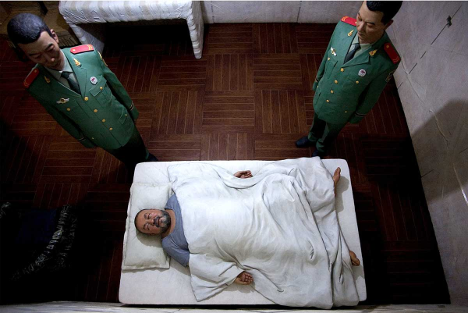
Then the target changes from the market to the state. After the 2008 Sichuan earthquake, Ai Weiwei organised an investigation into the deaths of schoolchildren in poorly built classrooms, and the names and belongings that resulted became art. At that point the practice stopped being chiefly a quarrel with the art world and became a quarrel with power. The consequences are well documented: surveillance, the destruction of a studio, a detention in 2011.
Exile extended the geography without softening the work. Ai Weiwei had lived in Berlin since 2015 when he brought Law of the Journey to Sydney in 2018. Reuters described it as a 60-metre inflatable raft carrying about 300 oversized human figures, and reported that it was made from the kind of rubber used by vessels ferrying refugees across the Mediterranean. In the same coverage, Ai Weiwei said the setting suited the work because of Australia’s offshore detention of unauthorised boat arrivals, and called the country’s refugee record poor by international standards. He has, in other words, already used Sydney Harbor once to place an uncomfortable fact before a comfortable audience. The career has an arc, from questioning objects to questioning systems of value to questioning states, and Mushrooms belongs to the third phase.
Reading Mushrooms
The work deserves a careful reading before anyone conscripts it into an argument, this essay included.
Elizabeth Fortescue’s report in The Art Newspaper supplies most of what is publicly known. An artist’s statement says the title points to several meanings at once: growth in darkness, nuclear mushroom clouds, and, in Chinese, a word that also suggests endless delay. Ai Weiwei says the idea began when Germany offered 5,000 helmets to help Ukraine just before Russia’s February 2022 attack, an offer that drew international ridicule as laughably inadequate. The sculpture is therefore a work about proportion: the helmet is the smallest possible answer to a war, offered by a state that could have given more.
Ai Weiwei calls it “a metaphor and a warning,” but rejects the idea that it is a political gag. He argues that today’s national leaders understand the human condition only shallowly, that civilisation is young and has not yet built adequate restraints on the actions of states, and that the sense of security we take for granted could disappear quickly. He also says his uncertainty stems not only from war but from rapid change in technology, artificial intelligence included, which he sees as testing existing systems of value.
The form carries much of this without help. Ten tidy rows of identical objects suggest military discipline, a cemetery and a crop all at once, and this is our reading, not the artist’s. Cast iron is heavy, cold and slow to decay, so a piece of protective equipment becomes monumental and faintly funereal. Uniformity is the central device. A single helmet is equipment, but five hundred of them describe how institutions imagine protection: in bulk, in standard issue, from a distance.
The site completes the effect. Set against the most photographed water in Australia, the work forces a collision between spectacle and warning. Visitors will photograph it because the view demands photographs, and some will find it handsome. That is not a failure of the work. It is the situation the work operates in, and it is where the 90% question becomes concrete.
One caution is necessary. On the evidence, Mushrooms is not a work about the art world. It is about complacent power. The link to the argument of this essay is one we are drawing and not one the artist makes. We think the link is legitimate, because a verdict on art and a warning about power share the same criterion, which is whether the thing tells us something we would prefer not to hear. But the joint where the two are welded should be visible.
Dissent as a Medium, and the Trouble With Being Welcomed
The phrase “dissent as a medium” names what is distinctive in Ai Weiwei’s method. Most political art treats politics as a subject: it depicts a protest, illustrates an injustice, comments on an event, and leaves the viewer safely outside. Ai Weiwei’s strongest work treats dissent as a material, something with weight, scale and consequence of which the work is physically made. The rubber in Law of the Journey belonged to the world it described. The iron in Mushrooms is the substance of armour. Repetition does similar work: sunflower seeds, backpacks, figures in a boat and helmets in rows are all multiples, which is how states and markets see people, and the individually trivial unit becomes collectively overwhelming. And the artist’s own exposure is part of the work, a fact critics argue about but cannot easily subtract.
This is where the criterion gains force. If real art questions the existing order, dissent is no optional theme but the test, and the test can be applied to any work, however abstract: what established judgment does this put under pressure?
The essay must now turn on its own subject, because the more interesting problem is not whether Ai Weiwei is right but what it means that he is welcomed. He is shown and commissioned by major institutions and represented by major galleries; the image credits for Mushrooms name Ai Weiwei Studio, the MCA, Galleria Continua and Lisson Gallery. The commission is funded through a philanthropic foundation and sits on the prime outdoor site of a national museum. None of this is scandalous, and all of it is how contemporary art works. But it creates a real tension with the 90% claim, and the tension runs in both directions.
One argument holds that an institution commissioning a critique of the existing order demonstrates its own open-mindedness and converts dissent into cultural capital. The better a system is at hosting its critics, the less they threaten it, and the sanctioned dissident becomes the system’s most sophisticated product. The opposing argument is that institutions are not monoliths and public sites are contested ground. A work on a famous lawn reaches people who would never enter a gallery, and a system that hosts critique may be altered by it, slowly. The alternative, a dissident without a platform, is not obviously preferable.
The limits are real and they move. In November 2023, The ARTnews reported that Lisson Gallery had canceled an Ai Weiwei show in London over a tweet about the Israel-Hamas war, with the artist defending free speech at length while saying the gallery’s decision was made with his own wellbeing in mind. Whatever one thinks of that dispute, it shows that tolerance has an edge, that artists and galleries find it under pressure and in public, and that everyone in the room is party to the negotiation. The honest position is neither cynical nor naive. Ai Weiwei’s acceptance does not disqualify his work, and it does not prove that the establishment is open. It shows that the relationship between critique and institution is negotiated continuously.
What Comfortable Art Looks Like
If garbage means art that does not question the existing order, we need a more careful account of what that looks like, because “comfortable” is not a synonym for “bad.” Most comfortable art is not cynical. It is simply built so that nothing in the room has to change.
Its most familiar form is the decorative: work that makes a space more agreeable and asks nothing further, which has honest uses and goes wrong only when it claims more for itself. A second form is the speculative, a work shaped by an anticipated buyer, familiar enough to be recognised and new enough to be priced. A third is institutional, where boards, sponsors and budgets reward predictability, so that comfort becomes structural and individual curators resist it at a cost. A fourth, and the hardest to see, is performative dissent: work that borrows the look of protest, with raw materials, urgent color and activist vocabulary, while risking nothing. Here the 90% problem reaches inside the avant-garde, since a style of questioning can become as comfortable as any other style.
There is also a newer pressure. Image-making is now abundant, cheap and frequently polished. When a competent surface costs almost nothing, “is it well made?” discriminates less than “does it stake anything?”, and the art market’s appetite for conviction, authorship and provenance may grow for that reason. That is a prediction and not a finding, and the same caution applies to the broader claim that a cooler market makes collectors more self-critical. We offer both as our own readings of the field, not as data.
What follows for each reader differs. An artist might ask what is at risk in the work and for whom, imagining the most sympathetic possible viewer and checking whether the work would tell that person anything new. A collector might ask whether she is acquiring a position or a surface, remembering that what she buys tells the field what to produce. A curator, dealer or critic might ask what he platforms and what he declines, and whether his reasons in refusing a risky work concern the work, the audience, or his own comfort. These are not rules. They are disciplines, and they cost something to keep.
Objections and Replies
Ai Weiwei’s claim invites objections, and the argument is stronger for meeting them.
The first is that the number is arbitrary and self-flattering. That is true of any rule that condemns most of what exists, but the percentage is rhetorical, and what survives it is the criterion. One can reject “90%” and still ask whether a given work questions anything.
The second is that history keeps reversing its verdicts: work derided in its time is revered later, and the reverse is equally common. This counsels humility about individual judgments, not abandonment of the question. A criterion based on function, on whether a work challenges or confirms, is arguably less hostage to changes of taste than one based on style.
The third is that a healthy ecosystem needs a large, unremarkable middle, since much of what keeps artists employed and communities engaged is neither radical nor meant to be. That seems right. The claim need not be that the middle should vanish, only that it should not mistake itself for the summit.
The fourth is the strongest, and Ai Weiwei’s own career is its best exhibit: questioning the order has itself become a style. When critique is marketable, institutions collect it and artists can perform it, and the criterion risks being satisfied by costume. The reply is that the test must concern risk and consequence and not vocabulary. The question is not whether a work looks critical but whether it costs anyone anything, including its maker, its commissioner and its buyer.
A last objection concerns the setting. A work on a famous harbor borrows significance from the view, and early judgments formed before it may be distorted. That is a reason to read Mushrooms alongside the artist’s earlier work and statements, and to treat the first weeks of its reception with some reserve.
Back to the Lawn
For the next seven months, five hundred iron helmets will stand between a museum and one of the world’s most photographed harbors. Visitors will take their pictures. Some will find the work beautiful. A few will read the title and think about a war, or about the gap between what a government offers and what a crisis requires.
Ai Weiwei told The Art Newspaper that speaking out on human rights and freedom of expression is the final form of resistance still available to humanity, and that this thinking lies behind Mushrooms. It is a large claim, and one need not accept it to notice what it implies for the art world: that speech without cost, art without question and comfort without friction are not neutral. They are choices, and each of us makes them.
The title’s question therefore stays open, and it is addressed to the reader. In the studio, the collection, the gallery, the programme, the commissioning budget, is the work among the ninety or the ten? And what, concretely, would have to change for the answer to be different?