There is a curious contradiction at the center of Ruth Asawa’s place in American art history: an artist who fundamentally altered the possibilities of sculpture has spent much of the postwar period sitting just outside the canonical narrative her innovations should have helped define. That narrative has largely been built around David Smith’s monumental ambitions, Alexander Calder’s kinetic experiments, the industrial austerity of Donald Judd and Minimalism, and Eva Hesse’s material investigations. Within that framework, Asawa has too often been filed as a compelling parallel figure — a gifted maker of delicate wire sculptures, an important woman artist, a beloved San Francisco civic presence — rather than recognized as one of the artists who redefined what sculpture could be.
The recent extraordinary attention to her work makes that omission increasingly difficult to sustain. The Witney Museum’s Ruth Asawa: Through Line (2023–24) brought her drawings into direct conversation with her sculpture, arguing for the continuity of line, repetition, and spatial perception across her six-decade practice. It was followed by the expansive Ruth Asawa: Retrospective, co-organized by SFMOMA and MoMA, which traveled from San Francisco to New York and is now on view at the Guggenheim Museum Bilbao through September 13, 2026, ahead of a final stop at Fondation Beyeler this October. These shows have done more than revive interest in an underappreciated artist — they have exposed the inadequacy of the categories through which postwar sculpture has traditionally been read.
Asawa’s significance doesn’t rest on the beauty or technical ingenuity of her wire constructions alone, though both are considerable. It rests on the radical spatial proposition embedded within them. At a moment when American sculpture increasingly prized mass and monumentality, Asawa built a language of permeability, repetition, transparency, and negative space, turning line into volume without sacrificing its linearity and creating enclosure without ever closing off the interior. To reconsider her today is to ask whether the story of postwar American sculpture has been told too narrowly all along.

Sculpture as an Optical Event
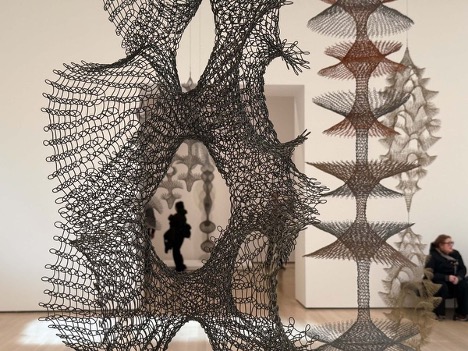
Encountering one of Asawa’s looped-wire sculptures produces a distinct perceptual instability. From a distance, the work reads as a coherent, biomorphic volume; step closer, and that apparent solidity dissolves into thousands of individual loops, through which the surrounding architecture, light, and viewer’s own body remain visible. The sculpture encloses and opens at once, establishing a boundary that refuses to function as a barrier, so that its physical presence depends on the very emptiness surrounding and penetrating it.
This paradox is the foundation of the work’s formal intelligence rather than an incidental effect. Asawa’s sculptures unsettle the conventional distinction between positive and negative space, because the voids inside the wire are not passive intervals between material elements — they actively shape how light travels through the form, determine the shadows cast onto nearby walls and floors, and shift continually as the viewer’s position changes. The result is a sculpture that resists being fully grasped from any single vantage point: as a viewer circles the piece, the relationship between interior and exterior keeps reorganizing itself, lines overlap and separate, and the implied volume seems to expand or contract. The sculpture becomes partly an object and partly an event of perception, drawing the surrounding room into its meaning. This is why calling Asawa a “wire sculptor,” while technically accurate, undersells the achievement. Wire was her medium; space was her actual subject.
The Black Mountain Foundations
Asawa’s understanding of space was cultivated inside one of the most experimental artistic environments of twentieth-century America. After the wartime incarceration of Japanese Americans severely disrupted her family life and education, she enrolled at Black Mountain College in North Carolina in 1946, entering an environment that deliberately dismantled the boundaries between fine art, craft, design, architecture, performance, and daily life. Under Josef Albers, she absorbed an approach to art that treated perception as an active process rather than a passive act of reception — the idea that materials carry no fixed meaning, and that what we see is determined entirely by relationships between colors, forms, surfaces, spaces, and the position of the observer. Asawa internalized this lesson thoroughly, even as she translated it into a sculptural language very different from Albers’s own investigations of color.
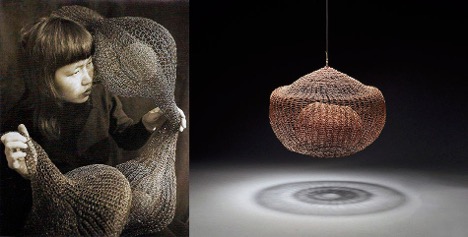
Her time at Black Mountain also placed her within an unusually porous intellectual community, alongside figures like Buckminster Fuller, Merce Cunningham, and John Cage, all challenging inherited boundaries between disciplines through structures of movement, architecture, mathematics, and material experimentation. Asawa carried that interdisciplinary sensibility forward, but she channeled it through a deceptively humble material. Her revolution didn’t depend on an exotic or technologically advanced medium; it depended on demonstrating how radically an ordinary substance could be transformed through sustained, disciplined attention until wire ceased to function as mere structural support and became, instead, a drawing extended into three dimensions.
When Line Leaves the Page
One of the most productive developments in recent Asawa scholarship has been the recognition that drawing was never peripheral to her sculptural practice — it was foundational to it. The Whitney’s Through Line exhibition made this case explicitly, presenting more than a hundred works on paper to demonstrate that a continuous investigation of line ran through her entire career. Seen this way, the wire sculptures can no longer be regarded as objects that simply happen to incorporate linear material; they become extensions of a lifelong inquiry into what a line can do once it leaves the constraints of the page. On paper, a line moves across a flat surface and links one point to another. In Asawa’s sculptures, that same line enters the volume of a room, bending around itself, generating surfaces, producing shadows, and enclosing space — all while remaining recognizably, insistently a line rather than a representation of volume.
This places Asawa within a significant lineage of twentieth-century artists who sought to free drawing from the two-dimensional plane, from Julio González‘s conception of “drawing in space” to Calder’s linear constructions and David Smith’s steel compositions, each expanding the idea that sculpture might function pictorially rather than through solid mass alone. Yet Asawa’s solution remains distinct from theirs. Smith transformed industrial steel into an almost calligraphic language of gesture and weight, asserting the material presence of metal even as his forms turned pictorial. Asawa transformed thin wire into a permeable membrane through which space itself becomes visible, achieving her effect precisely by letting material and space become inseparable. Where Smith could be said to have monumentalized line, Asawa dematerialized it — and in doing so, she didn’t merely draw in space. She constructed space out of drawing.
Negative Space as Material
Asawa’s treatment of negative space directly challenges one of sculpture’s oldest assumptions: that sculptural form is fundamentally a matter of material occupying space. From the monumental stone and bronze traditions of European sculpture through the welded steel of postwar American modernism, sculptural presence has typically been tied to mass, weight, and physical resistance — even the thinnest industrial materials of the twentieth century retained a sense of substantiality, their slenderness legible as a demonstration of material strength rather than its absence.
Asawa proposed a different ontology for the sculptural object, one in which her forms are defined as much by what they exclude as by what they contain. The interior of an Asawa sculpture is not an empty cavity waiting to be looked into but an active spatial field, structured by the repeated geometry of the wire: light penetrates it, shadows extend it outward, and the surrounding room becomes visible directly through it. This is one reason her sculptures carry such a powerful relationship to architecture — they don’t simply occupy a room, they alter the viewer’s perception of it, their shadows extending across walls and floors while their transparent surfaces fold the surrounding space into their own visual structure. The sculpture becomes a permeable event rather than an autonomous object, in which form, environment, light, and viewer stay continuously entangled. If the empty space inside a sculpture counts as part of the sculpture, and if the shadow it casts belongs to the experience of the work, then the distinction between form and void becomes genuinely unstable — and perception itself becomes one of the materials from which the work is made. Asawa arrived at questions that would become central to later twentieth-century sculpture and installation practice through remarkably simple means.
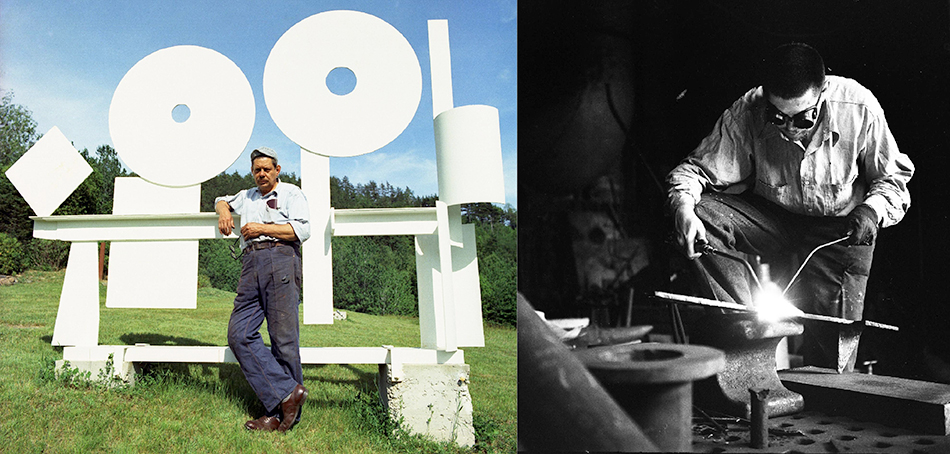
Two Sculptors, One Question: Asawa and David Smith
David Smith occupies a privileged position in the story of postwar American sculpture because his welded steel constructions transformed industrial materials into a language that was simultaneously sculptural and pictorial, their scale and physical weight asserting sculpture’s traditional material authority even as they began to draw in space. Asawa’s achievement can be understood as an alternative response to that same historical problem: where Smith asked how industrial material could become drawing, Asawa asked how drawing could become spatial structure without losing its essential character as line.
The contrast between them is especially revealing because it exposes assumptions about gender and material embedded in the conventional narrative of American modernism. Smith’s steel, welding, industrial fabrication, and monumental scale fit comfortably within the heroic mythology of the postwar American artist; Asawa’s wire, repetitive handwork, domestic working environment, and association with craft did not. Yet formally, the two artists were engaged in remarkably related investigations, both rejecting the sculptural object as a closed mass and seeking to activate the relationship between line, space, and viewer. Smith’s sculptures generally retain the authority of the industrial object even as they become linear; Asawa’s dissolve that authority into networks of repetition, transparency, and light. That distinction deserves a far more prominent place in the history of American sculpture than it currently occupies.
Calder’s Air, Asawa’s Stillness
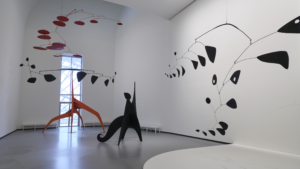
Alexander Calder offers a further comparison, since both artists understood sculpture as a structure existing in relation to air. Calder’s mobiles turned sculpture into a kinetic system in which movement, balance, and chance became integral to the work; Asawa’s suspended sculptures share that sensitivity to air, but their movement is perceptual rather than mechanical, changing continuously as the viewer shifts position and daylight moves across the surrounding architecture. Calder made air move the sculpture; Asawa made the viewer move through the sculpture’s perceptual field, achieving a comparable break from the static object without the spectacle of literal motion.

Repetition as Method: Asawa and Eva Hesse
The comparison with Eva Hesse brings questions of labor and repetition to the center of the discussion. Hesse’s work of the 1960s challenged the cool rationalism of Minimalism through materials that sagged, deteriorated, and accumulated, her repeated units never perfectly identical, so that repetition became her method for producing difference and uncertainty. Asawa’s repetition functions differently but is no less rigorous: each loop of wire is a small, almost insignificant gesture in isolation, yet thousands of such gestures accumulate into an elaborate spatial system that encodes the process of making directly into the final form. Where Hesse let repetition expose instability, Asawa used it to generate organic coherence, but both understood that a repeated hand gesture could function as a form of thought.
Unsettling the Craft Hierarchy
Asawa’s relationship to craft sits at the center of her contribution to modernism rather than at its margins. Her techniques drew partly on basketry traditions she encountered in Mexico, yet she transformed them into an entirely new sculptural vocabulary rather than simply reproducing an existing craft form, using weaving and looping to investigate structure, enclosure, and space. This matters because modern art history has long placed painting and sculpture at the summit of “fine art” while relegating weaving, basketry, and textiles to craft, treating industrial fabrication as progress and handmade process as tradition — a bias that has extended, too, to how seriously repetition itself gets taken depending on whether a machine or a hand performs it. Asawa’s work makes that hierarchy difficult to defend: her sculptures are unmistakably handmade, yet their concerns — abstraction, perception, spatial structure, materiality — are inseparable from modernism’s central questions. The problem was never that Asawa was insufficiently modern. It was that modernism lacked an adequate vocabulary for her.
An Avant-Garde Without Withdrawal
Asawa’s biography further complicated her critical reception, because she never conformed to the mythology of the isolated avant-garde artist withdrawing from ordinary life to pursue an autonomous practice. She raised six children, maintained an active home studio, participated deeply in San Francisco’s civic and artistic life, advocated for arts education, and created public fountains meant to be encountered outside elite museum spaces. Her commitment to community wasn’t separate from her art; it was part of her conception of what art could accomplish. This model of radicalism departs from the heroic narrative that equates artistic seriousness with withdrawal from ordinary life, demonstrating instead that formal experimentation could coexist with family and civic engagement, anticipating contemporary socially engaged practice well before the institutional vocabulary existed to describe it.
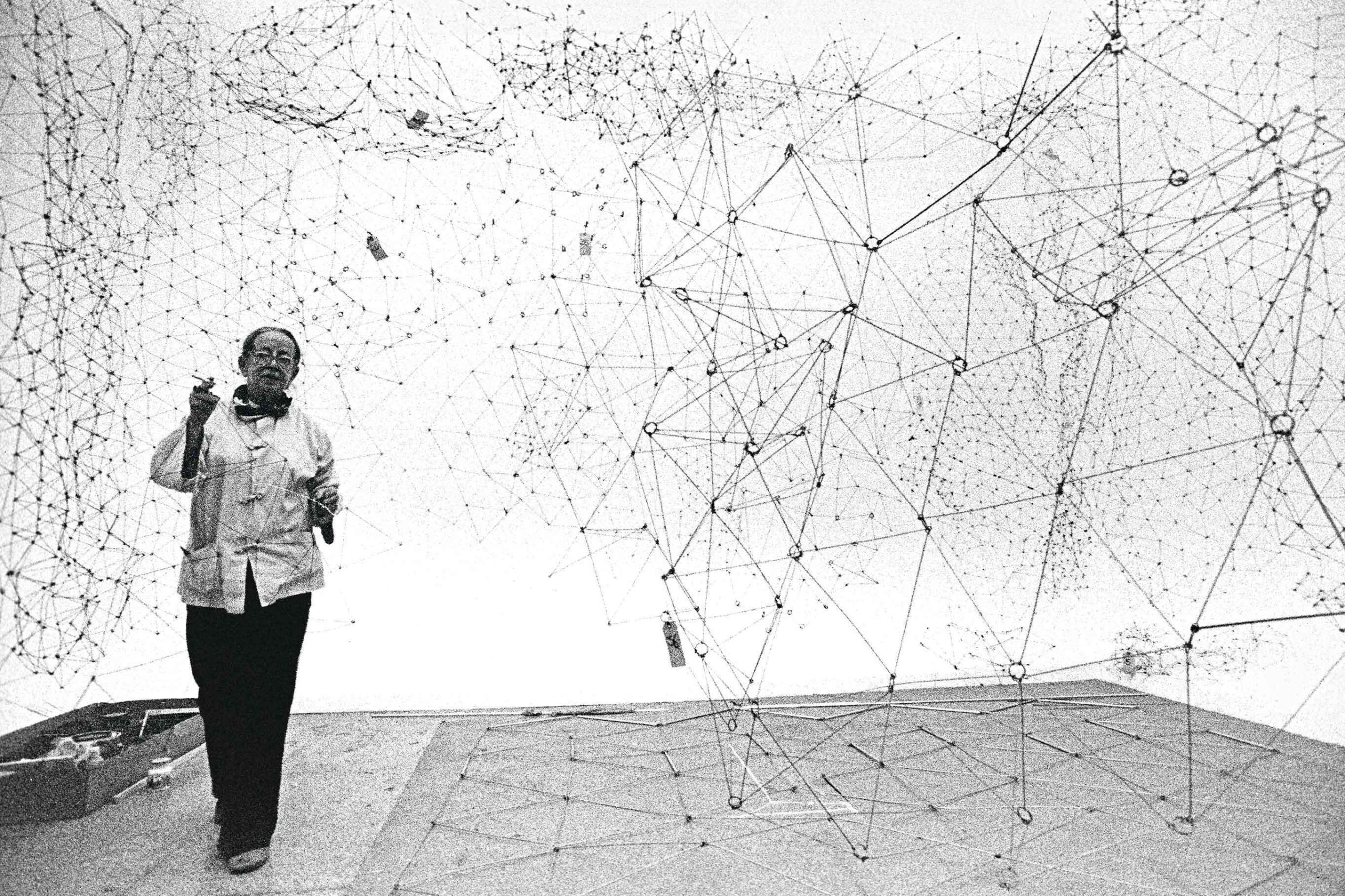
Toward Open Sculpture: Asawa, Gego, and Beyond Minimalism
A further comparison worth drawing is with Gego, the Venezuelan artist whose wire and metal constructions similarly dissolved the boundary between drawing and sculpture. Gego’s Reticulárea works transformed lines into expansive networks in which the sculptural object seemed to dissolve into a spatial field, neither a conventional volume nor a conventional drawing but something between and beyond both. Asawa belongs to this same broader movement toward what might be called open sculpture, defined not through mass but through relationships among line, interval, transparency, and space — a lineage suggesting that postwar sculpture’s history was not simply a march toward greater industrialization and objecthood, but a parallel movement toward permeability and dematerialization.
It’s tempting to call Asawa a precursor to Minimalism, but that framing diminishes rather than clarifies her achievement. She doesn’t need to be understood as someone who anticipated Donald Judd; she arrived at a different answer to the same historical question. Judd questioned sculpture’s conventions through discrete objects, industrial fabrication, and seriality, insisting on the object’s specificity; Asawa questioned the same conventions through transparency, handwork, and a deliberate dissolution of the boundary between object and environment, insisting instead on permeability. Minimalism made viewers acutely conscious of physical scale and architectural space; Asawa made them conscious of the very air through which the sculpture was perceived. This difference isn’t evidence that Asawa sits outside the story of Minimalism and post-Minimalism — it’s the reason she belongs inside it, expanding its terms rather than merely preceding it.
Why the Work Feels Contemporary Now
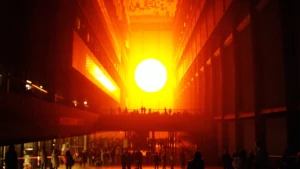
There’s a further irony to Asawa’s renewed prominence: much of what now makes her work feel contemporary is precisely what once made it difficult to classify. Today’s artists increasingly work across sculpture, installation, architecture, and digital environments, often deliberately destabilizing the line between object and setting, and transparency, networks, and immersive space have become familiar languages of current practice. Asawa explored these possibilities decades earlier without digital technology, her immersion perceptual rather than technological, her network handmade rather than computational, her spatial environment conjured from a few strands of wire rather than projection or sensors. This isn’t a claim that she worked ahead of her time, a phrase that flattens real historical difference — it demonstrates, more precisely, that the questions she pursued have proved durable, and that sculpture could become an experience rather than merely an object.

What This Renaissance Actually Corrects
The current institutional reassessment of Asawa is more consequential than a simple, overdue rediscovery. The SFMOMA and MoMA retrospective, following Whitney’s reconsideration of her drawings, frames her practice as an interconnected system rather than a set of separate categories — wire sculpture here, drawings there, civic activism somewhere else. Line connects drawing and sculpture; repetition connects craft and abstraction; public art connects aesthetics and civic life. That portrait should be understood not merely as a correction of gender imbalance, though that correction matters, but as a genuine challenge to the hierarchies of medium, labor, and scale that have shaped the canon. Asawa’s work asks why industrial steel has historically read as more intellectually serious than wire, why monumental scale has been equated with ambition, and why a commitment to family and community should ever be read as diminishing formal radicality.
Making Space Visible
The most revealing way to approach Asawa today may be to stop thinking of her as an artist who made sculptures out of wire, and instead recognize that she used wire to investigate the relationship between presence and absence. Her sculptures occupy space while exposing it, define boundaries while keeping them open, and create volume without ever becoming solid, turning repetition into structure and structure into something that resembles organic growth. Most importantly, they transform the act of looking into part of the work itself, which is why they can feel strangely alive — their forms seem to grow rather than have been merely constructed, appearing to breathe as air passes through them and to change as light moves across their surfaces and the viewer shifts position. Their apparent fragility is misleading: the wire may be delicate, but the intellectual structure behind it is extraordinarily strong.
Asawa’s real achievement was discovering that sculpture didn’t need to compete with architecture through monumentality, with painting through surface, or with industrial production through mass. It could instead operate through permeability, repetition, and the precise choreography of empty space — one of the more elegant challenges to twentieth-century sculpture’s material assumptions, built on the simple premise that a sculpture doesn’t have to fill space in order to transform it. The current reassessment feels less like a revival, in the end, than a correction in perspective. Once her practice is placed alongside Smith, Calder, Judd, Hesse, and Gego, the more revealing question is no longer why Asawa was overlooked for so long, but why an art history preoccupied with the transformation of sculpture took this long to recognize an artist who had already transformed its most fundamental elements — who took the line off the page, opened the sculptural object from within, and gave the void a structure. That is not a peripheral contribution to the history of American sculpture. It is one of its essential chapters.